
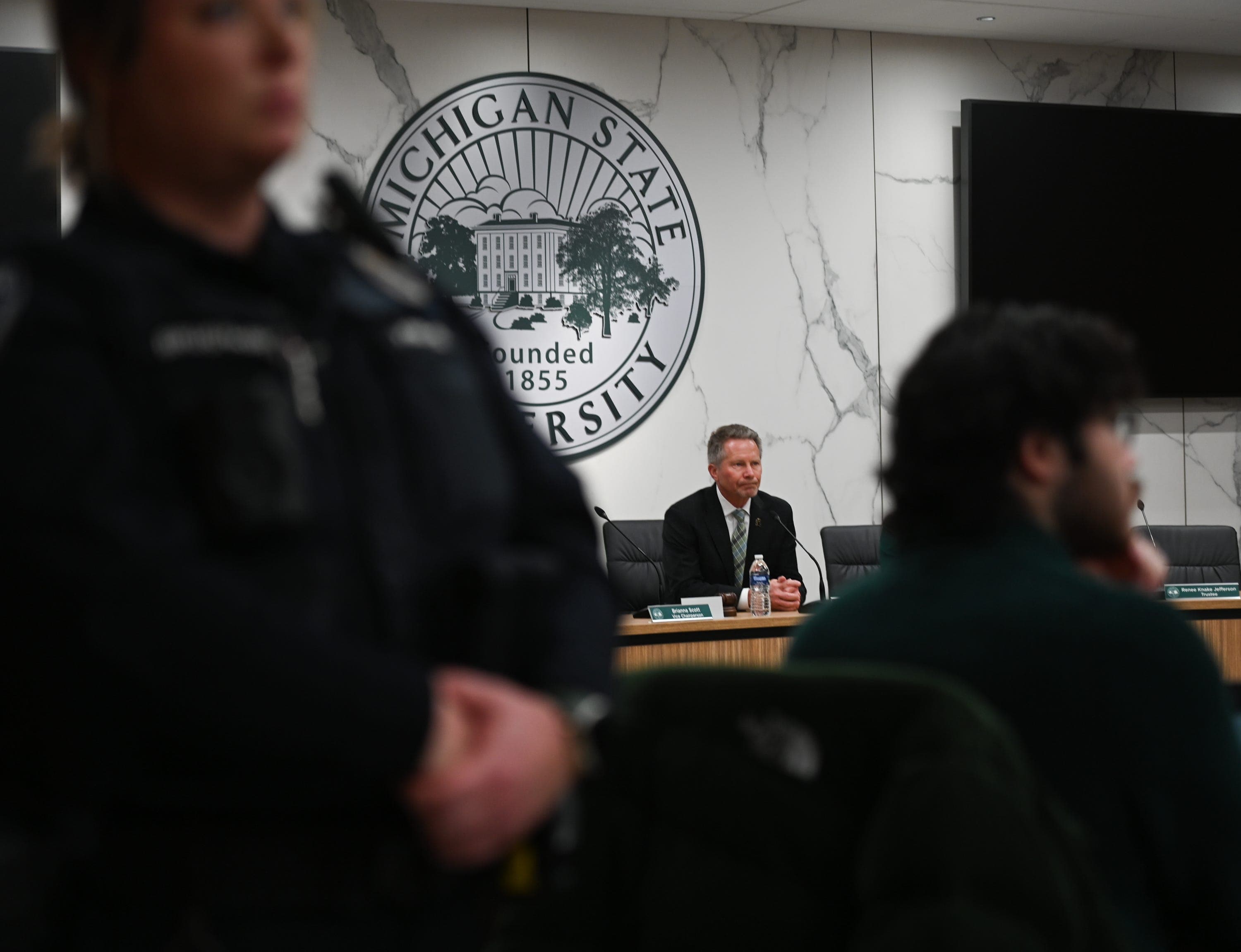
ANALYSIS: At a contentious Sunday evening meeting, MSU's Board of Trustees exposed the depth of their divide
The Zoom meeting showed an MSU board fractured over ethics rules, trustee speech, and a major pay raise for President Kevin Guskiewicz
The Michigan State University Board of Trustees’ special Sunday night meeting was officially built around two agenda items: revisions to the board’s Code of Ethics and Conduct and a personnel action. The meeting notice listed only those two topics, with the university saying the virtual meeting would begin at 8 p.m.
In substance, however, the meeting became a much larger confrontation over board power, trustee speech, due process, transparency, presidential retention, and the future of governance at Michigan State.
By the end of the meeting - after pointed debate - the board had approved revisions to its ethics code on a 5-3 vote and authorized a major revision to President Kevin Guskiewicz’s contract on a 6-1-1 vote. The proposed contract action would extend Guskiewicz’s appointment from March 4, 2029, to March 4, 2031, raise his annual base salary to $2 million, and increase his annual deferred compensation award to $250,000. MSU currently lists Guskiewicz’s annual salary at $1,029,210.
The votes revealed a board divided not simply over policy details, but over a more basic question: whether the board’s most urgent problem is disorder caused by trustees who publicly challenge the university, or whether the board’s most urgent problem is a governing majority attempting to restrain dissent by changing the rules.
Board Chairperson Brianna Scott, Trustee Sandy Pierce, Trustee Rebecca Bahar-Cook, Trustee Renee Knake Jefferson and Trustee Kelly Tebay supported the ethics-code revisions. Trustees Mike Balow, Dennis Denno and Rema Vassar opposed them.
Supporters framed the code changes as overdue governance reforms intended to restore discipline, protect the university from internal dysfunction, preserve the authority of the board as a collective body and help retain a president they view as highly effective and at risk of leaving.
Opponents framed the changes as a rushed, punitive and constitutionally suspect attempt to silence elected trustees, especially minority voices on the board, after public criticism of board decisions, administrative actions and MSU’s evolving governance structure.
The first dispute of the night was procedural. Balow questioned whether the meeting complied with notice expectations under the Open Meetings Act, noting that the posting appeared to fall inside the 18-hour window generally associated with public meetings. MSU General Counsel Brian Quinn and the board secretary said the board was in compliance, with the explanation that MSU’s Board of Trustees, as a constitutional corporation, has broad latitude and uses the Open Meetings Act as guidance rather than as a strict legal requirement.
Balow and Vassar also objected that the ethics-code revisions had not gone through the normal committee process. Vassar argued that board governance policies exist so proposals can be reviewed, edited, and scrutinized before coming to the full board. Scott said the board needed to act urgently.
These disagreements set the tone for the rest of the meeting. To the majority, the urgency was the point. Scott said the board had received outside governance guidance, including feedback at an April work session that amounted to a “failing grade.” She said some trustees had continued to undermine the president, the administration, and decisions made by the board, including through public statements and information shared with outside groups. She also said an inaccurate version of the resolution had been leaked to The Detroit News before the meeting, creating what she described as a false narrative.
To opponents, the urgency was itself part of the problem. Balow called the process an “abomination” and said the board was acting on a Sunday night when the matter could have gone through the usual channels before a regular June meeting. Vassar compared the timing to earlier board conflicts and said she was participating from Egypt at 3:14 a.m., despite the board knowing about the time difference.
The central substantive issue was the revised Code of Ethics and Conduct. Supporters said it clarified expectations around confidentiality, fiduciary duty, respectful engagement, and the board’s responsibility to govern itself. Bahar-Cook said trustees would still be free to ask hard questions, challenge assumptions, and debate issues in committees, work sessions, and board meetings. Pierce said she did not see anything in the revisions that prevented free speech, but said trustees should not leak confidential information or publicly spread inaccuracies.
Tebay made the majority’s governance argument most directly: the Michigan Constitution vests authority in the board collectively, not in individual trustees. Once the board acts by majority vote, she said, that becomes the settled direction of the university. From that perspective, continued public efforts to undermine board decisions are not healthy dissent; they weaken the collective authority Michigan voters placed in the board.
Opponents saw it differently. Balow argued that trustees are elected constitutional officers and must be free to speak publicly, including through op-eds and podcasts, even after the board majority has acted. He compared trustee dissent to Supreme Court dissents, arguing that minority opinions are part of American governance and do not amount to disloyalty.
Vassar went further, arguing that the policy would prohibit trustees from making critical public statements about board decisions, administrators, faculty, staff, or students after board action. She said the policy’s sanctions - including censure, loss of event access, removal from speaking programs, suspension of travel and removal from leadership positions - could take effect automatically if trustees refused to sign the revised code unaltered. In her view, that created punishment without due process.
The due-process concern became one of the sharpest dividing lines. Opponents objected to provisions they said could strip legal representation from trustees under investigation, and require surrender of personal devices. They also objected to a six-vote threshold for future amendments, arguing that if minority trustees were under investigation or recused, the policy could become practically impossible to change.
Supporters did not accept that interpretation. They argued that the board must have enforceable standards, that consequences are necessary when trustees violate confidentiality or governance principles, and that the policy does not prevent dissent within proper channels. Bahar-Cook said she would sign the code immediately and was not afraid of what it would do because, in her view, it strengthens the board rather than silencing it. Balow and Vassar both said they would not sign the new code.
The second major issue was whether the code was connected to President Guskiewicz’s future. Scott said the two agenda items were related because the board wanted to create an environment in which Guskiewicz could succeed. Pierce said the administration was frustrated by board conduct and that Guskiewicz, in particular, was at risk of leaving. She said he had not requested changes to the ethics code, compensation, or contract length, but that he was being aggressively pursued elsewhere.
The proposed personnel action was a significant one. Pierce introduced a resolution authorizing an amended employment contract that would extend Guskiewicz’s term by two years, raise his base salary to $2 million, and increase his annual deferred compensation from $200,000 to $250,000. The resolution also authorized Scott and Pierce to finalize the terms in consultation with the full board, using donor funds instead of money from the general fund in order to fund the difference.
Supporters argued that the move was necessary retention action. They pointed to Guskiewicz’s performance, donor confidence, administrative stability, and the risk of MSU losing another president after years of instability. Scott said Guskiewicz had modernized the university, built momentum through initiatives such as the Green and White Council, One Health, the Spartan Bus Tour, civil discourse programming, transfer-student success efforts, the Williams Scholarships, and expanded 1855 professorships. She warned that losing him could create a domino effect and make it harder for MSU to attract future leadership.
Opponents did not generally attack Guskiewicz’s performance. Balow said he thought Guskiewicz was doing a good job and wanted him to stay. Vassar said she respected him and believed competitive compensation could be appropriate through a proper process. Their objection was to the way the vote was handled.
Balow said trustees had not heard directly and collectively from Guskiewicz about what he wanted or needed. He said different trustees appeared to have received different information through private conversations, creating a “game of telephone.” He also raised concerns about whether the increased compensation could hit the university’s general fund. Pierce said she intended to secure outside funding and committed to returning to the board if that did not happen.
Vassar argued that the board had not seen an active competing offer, had not properly negotiated with Guskiewicz, and did not know with certainty where the money would come from. She said Quinn had acknowledged the process was not standard practice for employment contracts. In her view, MSU was “competing against ourselves” and manufacturing urgency without enough due diligence.
Supporters countered that waiting carried its own risk. Bahar-Cook said that if the board failed to act and Guskiewicz left, that would be on the board. Pierce said his frustration was real and that he was being pursued. Scott said the situation was more serious than critics acknowledged and that the board had a duty to act before it was too late.
The meeting also exposed deeper unresolved tensions involving Spartan Ventures, Spartan Media Ventures, outside counsel, prior investigations, and the board’s history of internal conflict. Vassar and Balow repeatedly referenced concerns about access to documents, NDAs, transparency, and whether trustees had enough information before voting on major initiatives. Pierce defended the need for confidentiality around competitive business structures and said trustees could review materials through proper channels.
In the end, the majority prevailed on both major items. The ethics-code revisions passed 5-3. The personnel action passed 6-1-1, with Balow voting no and Vassar abstaining.
The result is that MSU now has a revised trustee ethics framework and a board-approved path toward a much richer, longer contract for Guskiewicz. But the meeting did not resolve the underlying dispute. One side believes MSU cannot function if individual trustees continue to publicly challenge board decisions, criticize administrators, and revisit settled matters after votes are taken. The other side believes MSU cannot function if elected trustees are pressured into silence, denied full access to information, and punished for airing dissent on matters of public concern.
That is the real issue now before Michigan State. The Sunday meeting was not just about an ethics code or a presidential contract. It was about who controls the narrative of governance at MSU: the board majority acting as a collective, or individual trustees claiming an independent duty to speak beyond the boardroom.