
Inside Jack Stager’s exclusive sit-down with Tom Izzo
Spartan Sports Report delivers a moment years in the making, as Izzo opens up on culture, connection, and life beyond basketball
There are moments in college when the work stops feeling like preparation and starts to feel real. For MSU senior Jack Stager, that moment came inside the Spartan Newsroom this week.
On what he called a historic day for Spartan Sports Report, Stager – a Michigan State student, host, and reporter – sat across from Tom Izzo and led an exclusive, wide-ranging interview that went far beyond basketball. It was the kind of opportunity journalists spend years chasing, and in this case, that timeline was literal.
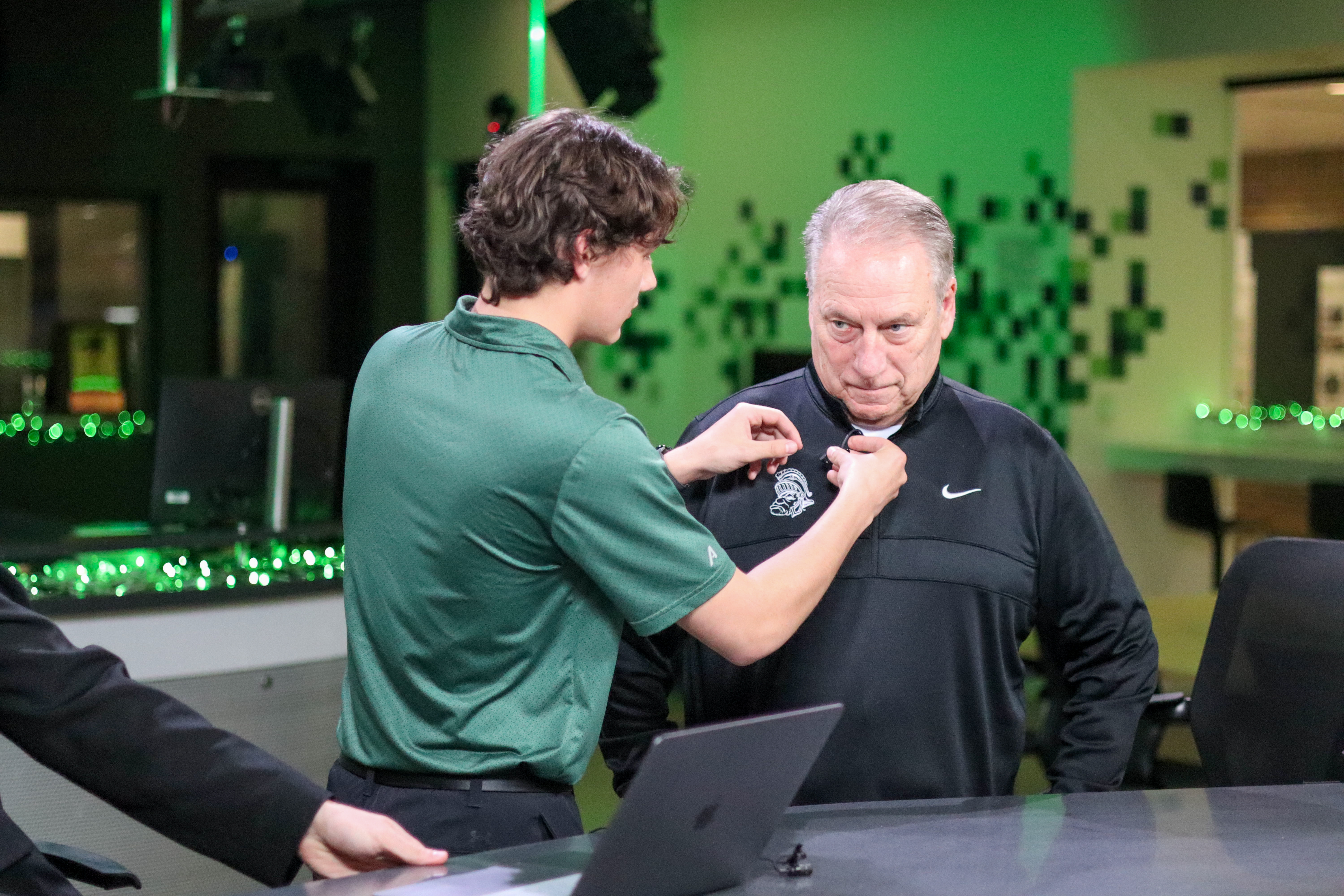
 Jack Stager and Tom Izzo. Photo credit: Chris McAuliffe
“We had been planning this for three years,” Stager said. “And I truly could not have imagined it going as well as it did.”
That sense of build-up mattered, because nothing about the moment was accidental. Spartan Sports Report, produced by students in JRN 404 and supported by a group of committed volunteers, is designed for exactly this kind of opportunity. Filmed inside the School of Journalism’s Spartan Newsroom and often working alongside Big Ten StudentU, the show gives Michigan State students a platform to do the work, not just study it.
 Photo credit: Chris McAuliffe
And on this day, the work met the moment.
“It was the most unbelievable experience,” Stager said. “Izzo was so kind to us and open to talking.”
From the start, the tone felt different.
Izzo walked into the newsroom and immediately leaned into the environment, acknowledging how comfortable he felt around the students and how meaningful a space like the communications center is to Michigan State as a whole. For a coach who has spent decades navigating traditional media settings, this felt more personal.
That fit exactly what Stager was trying to create.
“I wanted to get outside of basketball,” he said to Spartans Illustrated today. “Anyone can go on socials or YouTube and hear his thoughts on the season. I wanted this to be a space to learn more about him as a person, role model to many, and honestly just a ‘regular guy.’”
That intention shaped everything that followed.
The conversation did begin with basketball, as it naturally would, but even there, Izzo’s answers quickly expanded into something broader. He reflected on a season that ended in disappointment - as all seasons do that don’t end with a national championship - but also one that carried real substance.
Michigan State finished second in the Big Ten, navigated injuries that reshaped the roster, and still pushed into the Sweet 16 before falling to UConn.
Izzo didn’t dwell on excuses. He didn’t ignore the sting either. Instead, he framed the season within the larger identity of the program: consistency.
Over the years, he has had different rosters, different challenges, and different outcomes. The common thread, in his mind, is not perfection - but reliability.
Michigan State shows up. It competes. It expects to be part of the conversation every March. That expectation, he told Stager, is something to embrace.
“Pressure is a privilege,” he said, reinforcing a standard that extends well beyond the court.
In that room, filled with students preparing for careers in a competitive field, the message carried weight. Pressure does not show up randomly. It shows up when you are in a position that matters.
Stager understood that connection, and it influenced how he guided the conversation.
“There’s a lot of parallels in the responsibility and stress that everyday college students go through, just like him as a head coach,” he said. “Just on a different magnitude, of course. We don’t have thousands watching our every move, every success, every failure.”
That idea – shared pressure, different scale – became a bridge between Izzo’s world and the students sitting in front of him. It also opened the door to one of the interview’s most important themes: culture.
Izzo spoke at length about the difference between a transactional approach and a relationship-based one. In today’s college athletics landscape, movement is constant. Rosters turn over. Opportunities shift. For many programs, that reality has reshaped how they operate.
Izzo has chosen a different path.
He acknowledged that Michigan State has not leaned as heavily into the transfer portal as others, and that he hears criticism for it. But his reasoning was clear. Transactions last a season. Relationships last a lifetime.
That belief shows up in the way former players remain connected to the program long after they leave. Izzo pointed to events like Grind Week, where former Spartans return to campus, not because they have to, but because they want to. NBA players, overseas professionals, one-year transfers, long-term contributors – all back in the same space, reinforcing a shared identity.
He talked about watching former players across the league, about the calls that come in during the NCAA Tournament, about moments like Magic Johnson organizing a Zoom call before a postseason game to remind the team what it means to be a Spartan. The names change, the eras shift, but the connection remains.
“If you don’t have relationships, what do you have?” Izzo asked.
That question hung over much of the conversation. It also tied directly into what Stager was trying to do with the interview itself.
“I wanted it to be very open,” he said. “I didn’t want to fully script it. I had my topics, but I just trusted my instincts and trusted my relationship I’ve built with him and (men's basketball comms guy) Mex (Carey) throughout the years.”
That approach showed. The conversation didn’t feel rigid or rehearsed. It moved naturally, allowing Izzo to expand on ideas rather than just answer prompts. It created space for the interview to shift from basketball into something more reflective.
That shift became most clear when Stager asked Izzo for advice to students navigating the uncertainty and pressure of college life.
Izzo’s answer was immediate: it is okay to fail. It is okay to struggle. In fact, those things are often necessary if you are chasing something meaningful.
He pointed to his own record, noting the hundreds of losses that sit alongside his wins, and made it clear that failure is not something to avoid at all costs. It is something to learn from.
What matters is the response. Get back up. Stay committed. Surround yourself with the right people.
Izzo emphasized that last point by sharing the story of his lifelong friendship with Steve Mariucci. The two came from the same small town, shared the same ambitions, and held each other accountable. When one drifted, the other corrected him. That dynamic, he said, is critical.
Who you spend your time with shapes who you become.
For a room full of students building careers, that message landed with particular clarity.
The conversation then moved into one of the most emotional parts of Izzo’s philosophy – what it means when former players come back.
Stager asked how much it matters to see players, now with their own lives and responsibilities, still choose to invest time in the program.
Those are tear-jerking moments, he said.
He admitted they make him cry, because of what they represent. Respect. Connection. Enduring relationships. He spoke about the players who challenged him the most often becoming the ones who care about him the most later on, because he stayed with them through the difficult moments.
He also made something else clear - he hopes he is hard to play for.
He drew a parallel to professors in the communications building, saying he hopes they are hard to please, too. The goals students and athletes are chasing are not easy to reach. Only a small percentage of college players make it to the NBA. Only a small percentage of aspiring broadcasters reach the highest levels of their field. Pretending otherwise does not help anyone.
Demanding standards, in his view, are a form of respect.
That idea carried through as the conversation shifted toward Michigan State itself.
Izzo described the university as blue-collar, diverse, and deeply connected. He spoke about the reach of the alumni network, about the way Spartans show up across industries and around the world, about the shared identity that follows people long after they leave campus.
Then he reframed the student experience. Students, he said, are renting their place while they are here. What they do with that time determines what they leave behind.
If they pursue their goals, build relationships, and invest in the community, they add another brick to the foundation for those who come next.
 Photo credit: Chris McAuliffe
That idea mirrors the very existence of Spartan Sports Report.
This interview did not happen in isolation. It was built over years by students who came before, by relationships formed with athletic communications, by a reputation that allowed access like this to exist in the first place.
As the interview ended, Stager acknowledged that, but he also experienced something else that day that reinforced Izzo’s message even further.
“Izzo spent a half hour afterwards talking to each student in the room,” he said. “Answering more questions and giving insight and advice.”
That part does not show up in the final cut. It does not make headlines. But it might have been the most telling detail of the entire experience. It was the same philosophy Izzo had been describing, playing out in real time. Not transactional. Relational.
The interview continued to expand into Izzo’s own journey.
He admitted he never expected to reach this level, recalling a time when he and Mariucci used their scholarship money to buy a trailer and dreamed about coaching somewhere meaningful. Not a national championship. Not the Hall of Fame. Just somewhere that mattered.
He spoke about mentors who helped him climb, about setbacks along the way, about the sacrifices required to pursue a career at that level. Time with family. Trade-offs that come with ambition. Decisions that shape a life.
Then he offered one of the clearest frameworks of the entire conversation.
Do you like what you do? Do you love what you do? Or do you live what you do?
If you like it, you can be good. If you love it, you can be very good. But if you live it, you have a chance to be elite.
For a student like Stager, sitting there in that moment, the message was not abstract. It was visible in the work itself. Spartan Sports Report is built by students who choose to live it – to invest time, energy, and effort into something that goes beyond a grade or a requirement.
That is why this interview mattered.
Not just because of who was in the chair across from him, but because of what the moment represented.
Stager didn’t script every question. He trusted his preparation. He trusted the relationships he had built. He trusted the environment around him.
And in doing so, he created the kind of conversation he set out to have – one that revealed Tom Izzo not just as a coach, but as a person shaped by consistency, relationships, failure, communication, and a deep belief in what college can be.
For Jack Stager, it was an exclusive interview.
For Spartan Sports Report, it was a reflection of everything the program is designed to do.
And for everyone in that room, it was a reminder that the line between student and professional is not as far away as it sometimes feels.