
Breaking down the remaining Big Ten Tournament scenarios
The Big Ten Tournament is right around the corner. Find out how all the remaining games will impact the final bracket
The Big Ten Tournament (BTT) will start next Tuesday in Chicago. The final Tournament bracket will not be released until Sunday evening, but based on the total number of remaining Big Ten games, it is now possible to summarize all of the possible bracket configurations.
I have crunched all of the numbers, and I will use this post to summarize the current landscape of the Big Ten Tournament bracket as things change. Also stayed tuned to our social media channel for the most up-to-date information.
Update as of March 7 at 8 p.m.
Wisconsin went into Purdue and handed the Boilermakers yet another home loss at Mackey Arena. About an hour later, Ohio State held serve at home and took case of Indiana.
As a result, the number of remaining scenarios for the top 10 BTT seeds down to just 16. The table below shows the updated odds for the 16 possible remaining scenarios.
Table 1: All 16 scenarios for the top 10 seeds in the Big Ten Tournament
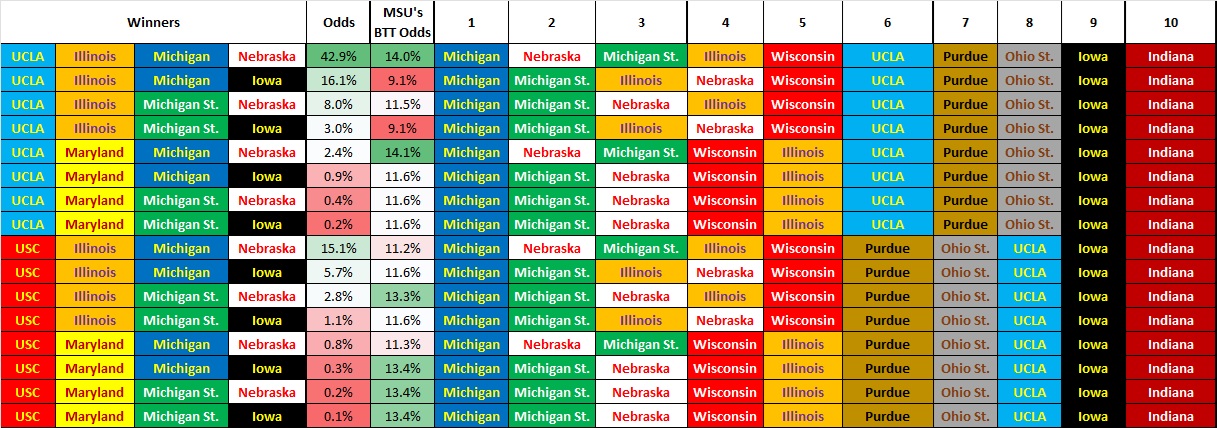
Note that Iowa has locked up the No. 9 seed.
The possible first opponents for MSU from the No. 6 or No. 7 seed positions are down to Purdue, UCLA, Ohio State. Assuming there are no upsets on Thursday, UCLA is just a hair more likely than Purdue (45.3% to 44.6%) to be MSU's first opponent on Friday evening. There is also about a 10% chance that the Spartans end up on a collision course with Ohio State.
Wisconsin is now locked into the No. 4 or more likely the No. 5 seed (95%). The Spartans can no longer face the Badgers until the final, assuming either team advances that far.
For completeness, the 32 possible scenarios for the bottom portion of the bracket are shown below. This table has not changed in the last 24 hours.
Table 1: All 32 scenarios for the bottom eight seeds in the Big Ten Tournament
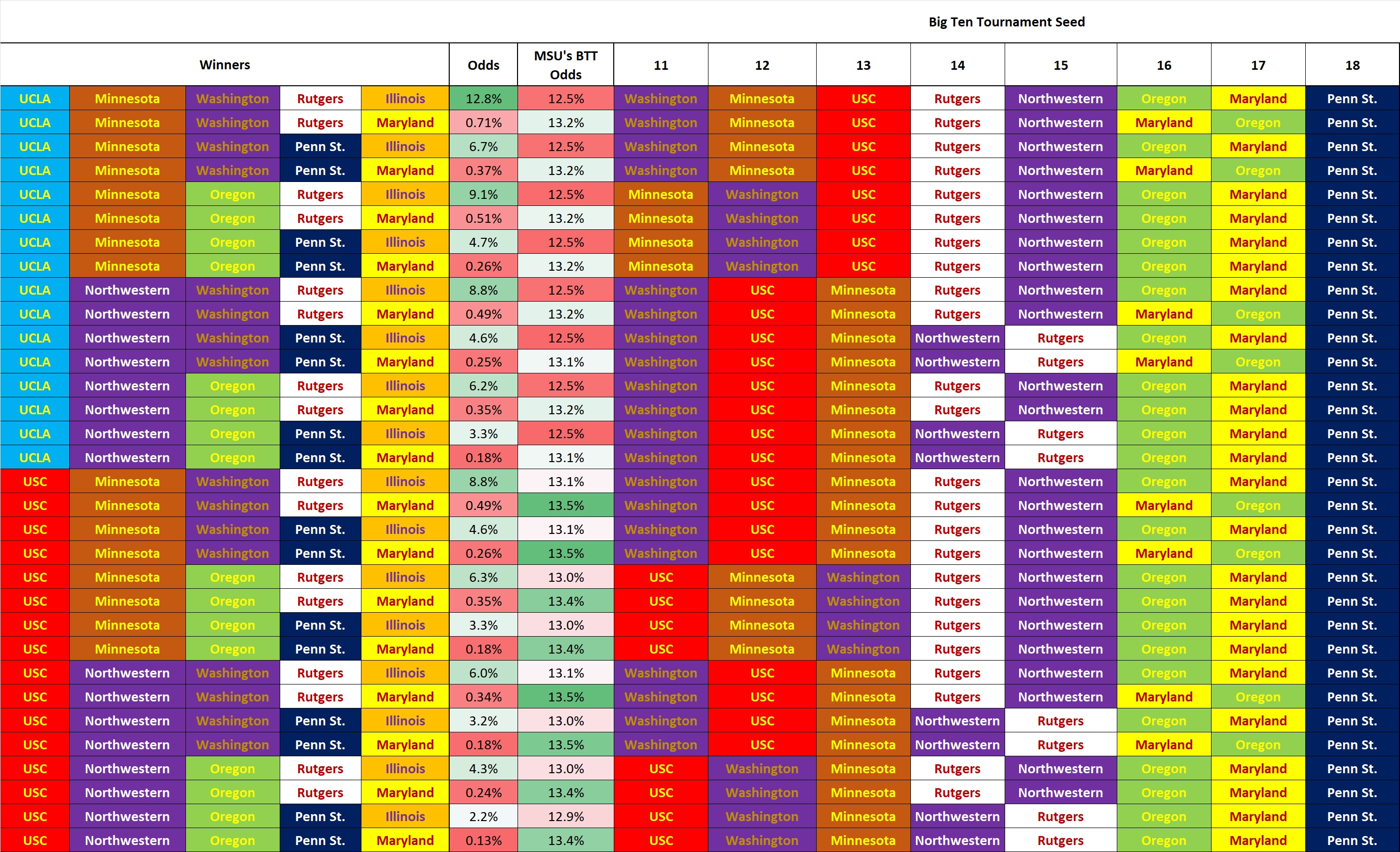
Seeds No. 11 and No. 14 are possible first opponents for Michigan State in the scenario where the Spartans are the No. 3 seed. Washington is the mostly likely No. 11 seed (61%) and Rutgers is the most likely No. 14 seed (86%).
In the scenarios where Michigan State draws the No. 2 seed, Indiana is already locked in as the No. 10 seed. The Hoosiers would also be a possible Friday night opponent for the Spartans if there is an upset on Thursday.
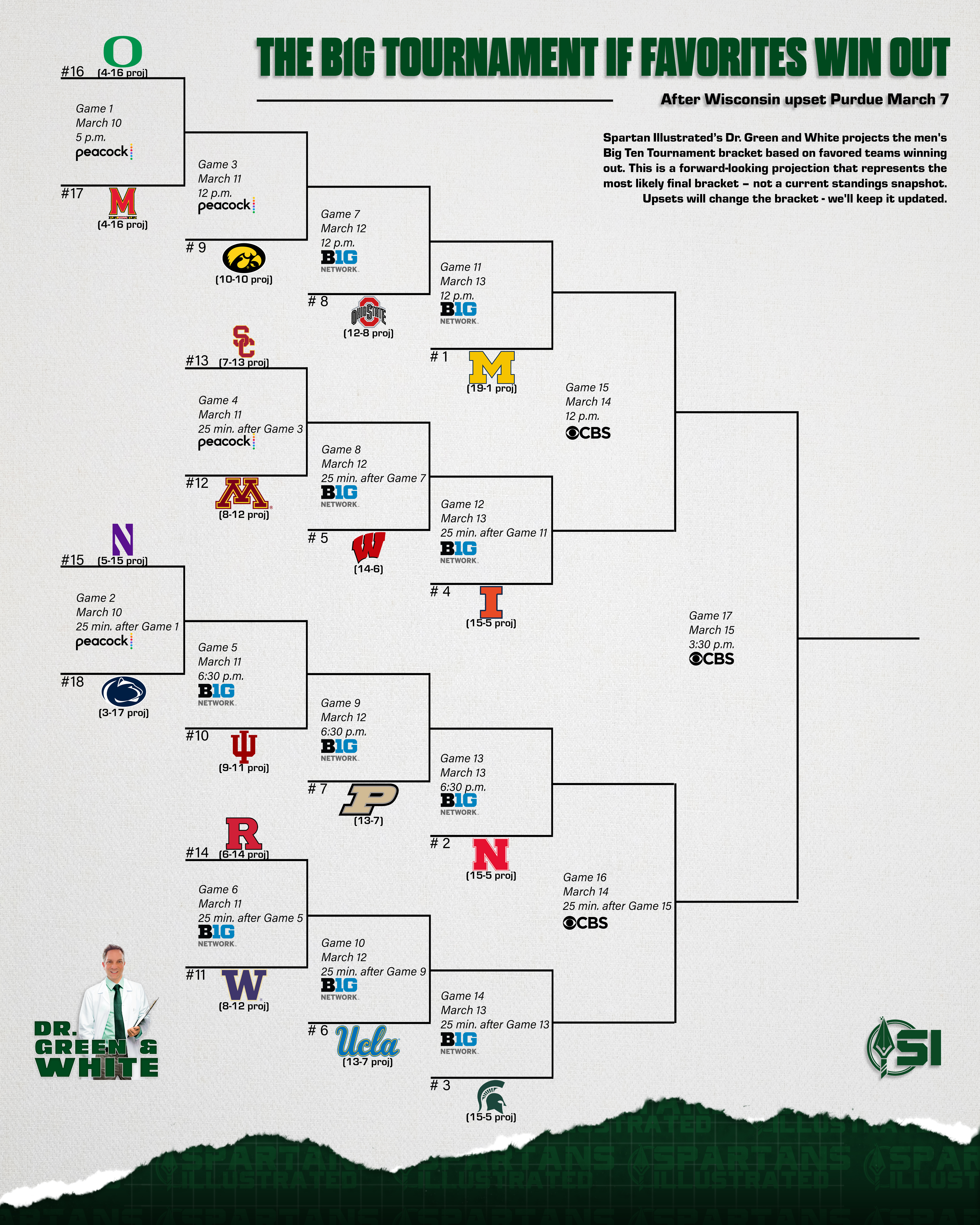
Overall, there are still 128 possible ways for the regular season to play out and 49 possible unique Big Ten Tournament configurations . If the favorites win all nine remaining games, which has odds of 14.3%, the figure below shows what the bracket would look like.