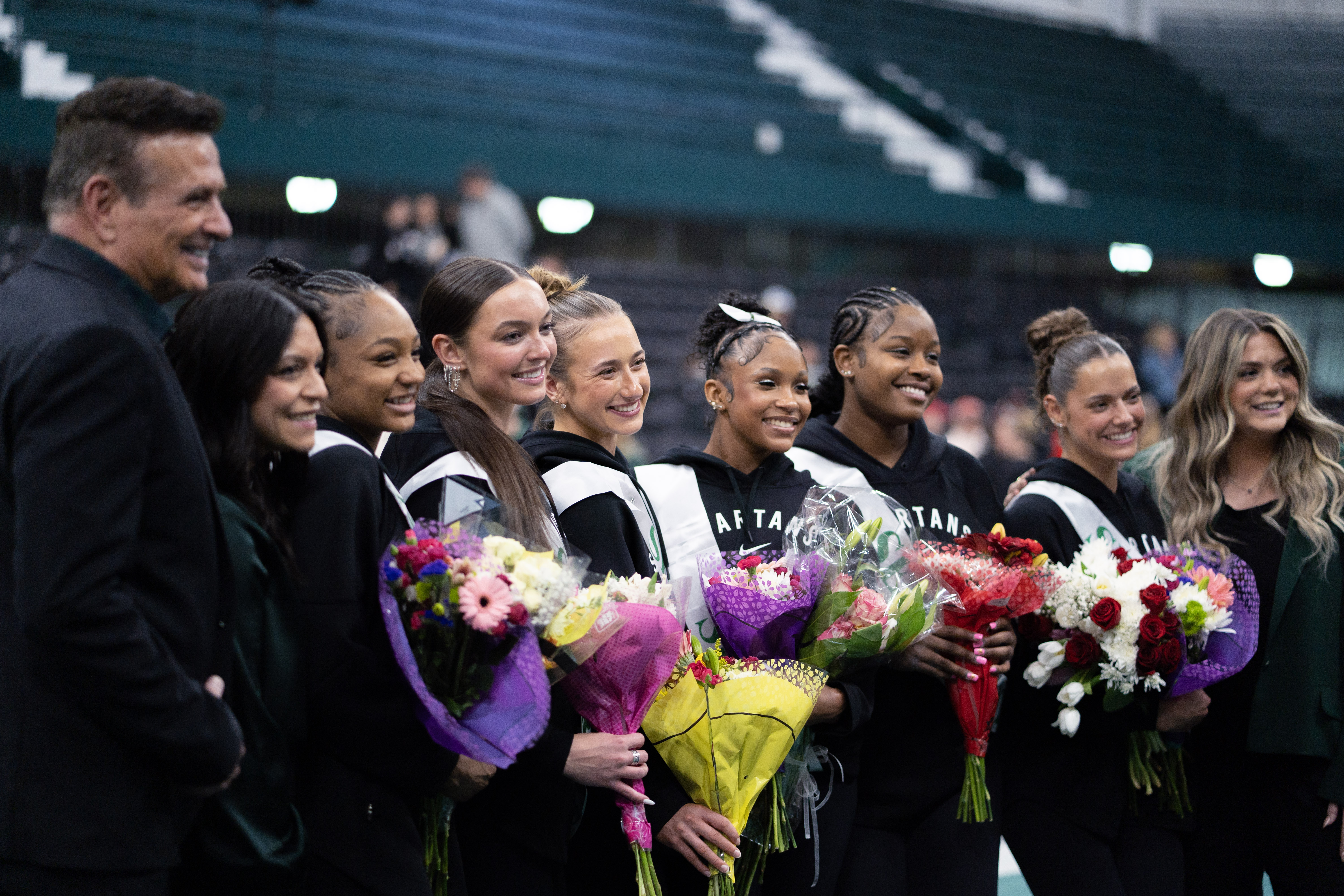
Built for this: Michigan State Gymnastics' depth delivers key win in Tempe
Spartans finish strong on floor and vault to secure fifth straight NCAA Regional final
For Michigan State gymnastics, advancing this far is no longer a breakthrough. It is the standard – and it has been built the hard way.
It's now five straight years, five straight NCAA Regional finals, even as this year's Spartans have been forced to replace 13 of their 24 routines because of injuries, including two more adjustments Thursday that brought freshman Isabel Biro into the lineup.
The level of depth and readiness across this roster has carried them here, showing up in a way rarely seen - in any sport - and on Thursday afternoon in Tempe, it carried them forward again.
This outcome did not happen by accident, and it did not begin in March or April.
Earlier in the season, before injuries reshaped the green and white lineup, there were quiet reminders inside the program about what depth actually requires. Not everyone would be in the top six on every event, and not everyone would see the floor right away. But the expectation was clear: prepare as if your turn is coming, because at some point, it will.
That is what strong teams do. They build beyond the visible lineup. They train beyond the moment. And when adversity hits, they do not scramble – they replace, they adjust, and they perform.
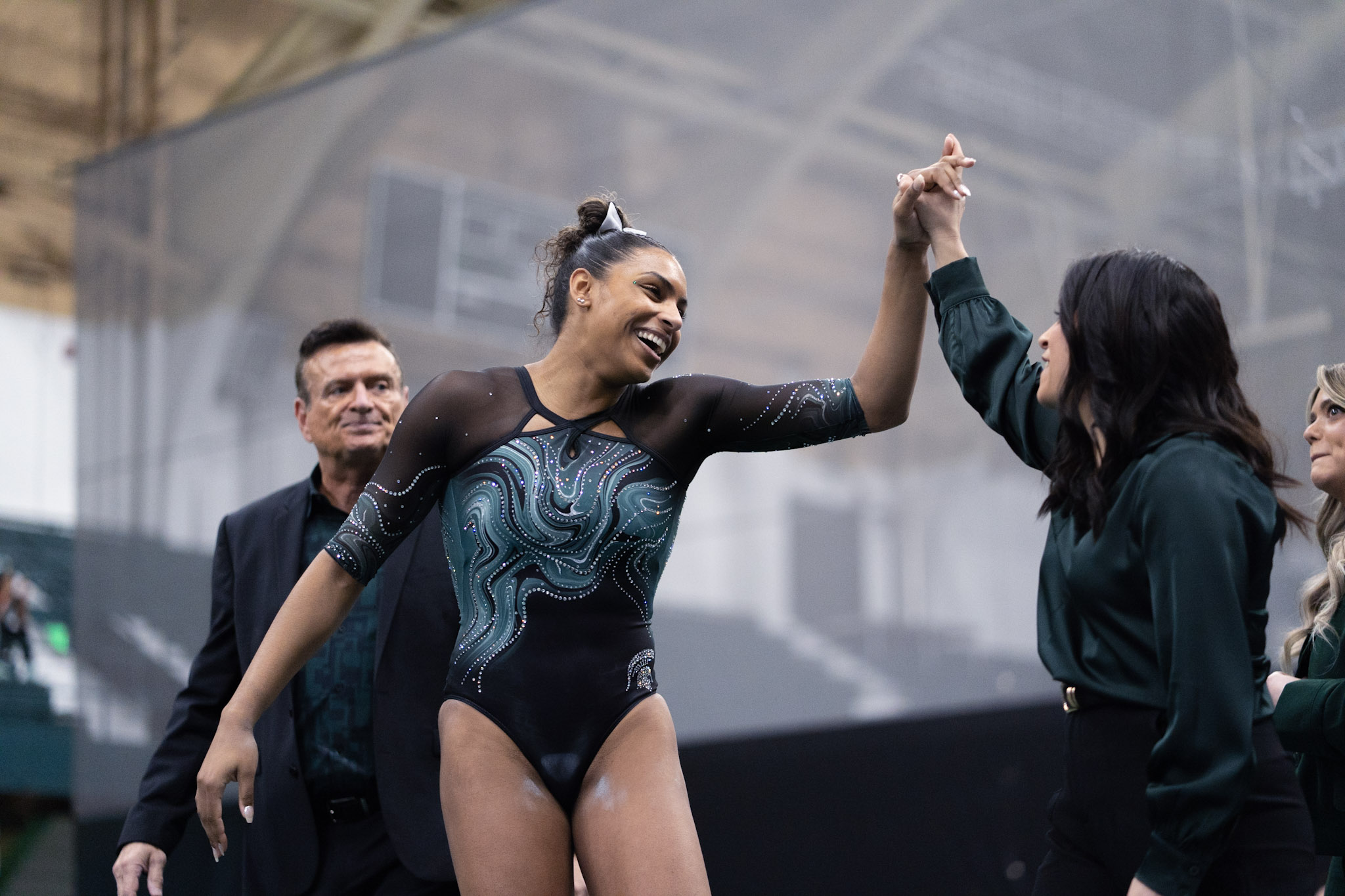 Photo credit: Sydney Padgett/Spartans Illustrated
Michigan State has lived that reality all season. The result has been a roster where every routine is backed by another ready to step in, and where opportunity, when it arrives, is met with execution rather than hesitation.
On Thursday, that foundation showed up again.
Michigan State, seeded No. 11 in the country, scored a 197.350 to rally past the field in the NCAA Tempe Regional semifinal, closing with authority to secure its place in Saturday’s regional final. The Spartans advanced alongside No. 6 Georgia, which finished second with a 197.125, as the top two teams from the session moved on. BYU (196.250) and Southern Utah (195.725) were eliminated.
In the second semifinal, No. 3 Florida (198.125) and No. 14 California (196.675) advanced past Penn State (196.200) and host Arizona State (196.050).
The path to that result was not clean from the start, and that, more than anything, is what made the finish meaningful.
“Feeling great, feeling great,” head coach Mike Rowe said. “You know, we still have some things we can iron out. We had some strange occurrences, a little adversity that we weren't used to ... but I'm so proud of the girls because I think they started decent and just built on each event and finished really strong.”
Michigan State opened on bars with a 49.200 and sat in third after the first rotation, trailing both Georgia and Southern Utah. Nikki Smith paced the group with a 9.925, while Sage Kellerman added a 9.900 in the anchor spot, but the rotation reflected what Rowe described – a start that was steady, but not yet decisive.
Beam kept the Spartans within striking distance. A 49.075 pushed the team total to 98.275 at the halfway point, moving Michigan State into second.
MaKayla Tucker and Isabella Trostel each delivered 9.850s, with Tucker anchoring the lineup for the first time in her career, a sign of both trust and growth within the rotation.
Still, the meet had not turned. That shift came on floor.
Michigan State posted a 49.500, the highest event score of the session to that point, and did so at the same time Georgia was forced to count a fall on beam.
Nikki Smith anchored with a 9.950, her tenth score of 9.925 or better on floor this season, and Gabi Ortiz matched it with a career-high 9.950. Korynne Marquart added a 9.900, and the Spartans moved into first heading into the final rotation.
For Rowe, the way the lineup responded mattered as much as the score itself.
“Today was good to see the growth ... even with the adversity that was thrown at us,” Rowe said. “They just kept building and building, and to come away with a win, that’s sweet.”
What followed on vault was the clearest expression of what this team has become.
Michigan State closed with a 49.575, punctuated by three consecutive stuck landings from Tucker, Smith, and Kellerman. Tucker posted a 9.950, Smith delivered a perfect 10.000 – the fifth of her career and third on vault – and Kellerman matched with another 9.950 to finish the meet.
For Smith, the moment unfolded with a clarity that only comes from repetition and feel.
“So many emotions, mostly excited,” Smith said. “I have like no words right now. In the air, I kind of knew that I was going to stick, so overall, I was just very excited.”
She described the instant as instinctive, almost quiet.
“It’s kind of silent, and you just have your body awareness, and it just felt right,” she said.
When she landed and turned back toward her teammates, the release was immediate.
“It was very exciting … just running back to them was a happy moment,” Smith said. “And just them cheering with me, I just love them so much.”
Smith’s performance extended well beyond a single moment, though. She finished first in the all-around with a 39.625, shared the top score on bars (9.925) and floor (9.950), and delivered the defining routine of the day on vault.
Tucker scored 39.400 to finish third in the all-around, reinforcing the depth that has allowed Michigan State to absorb adversity and still build toward a peak at the right time.
That depth has been tested throughout the season.
“It’s been like gut punch after gut punch,” Rowe said. “We just have to pick up and get the newbies ready to go and say, hey, you’re on. This is what you’re here for. And they’ve just been doing great. So proud of them.”
Smith echoed that perspective from within the lineup.