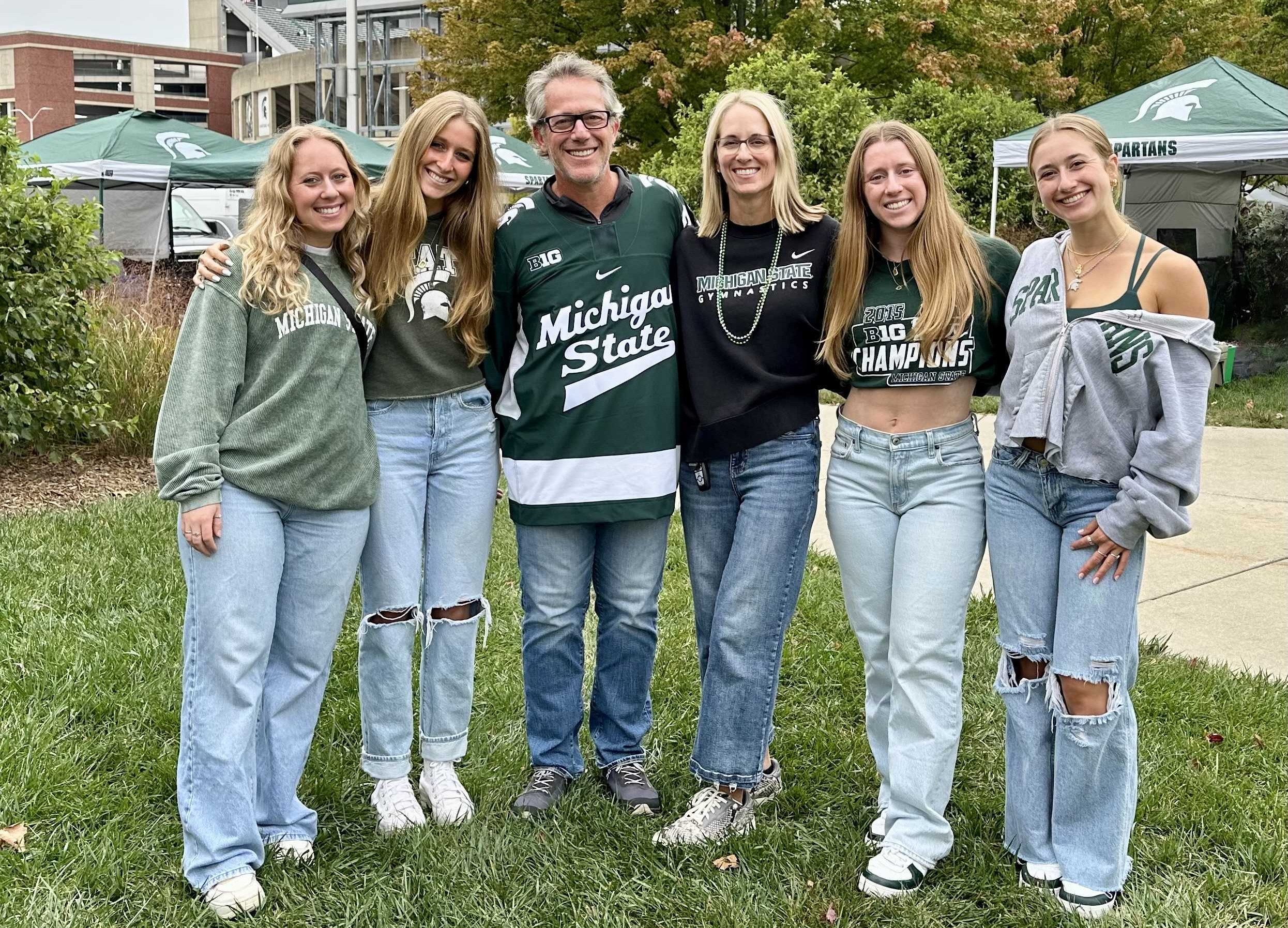
The Lebster family had a front row seat to watch MSU gymnastics rebuild itself
The Spartans have climbed from uncertainty to national prominence under the leadership of Mike Rowe
The music hits, and Stephanie Lebster runs onto the floor at Jenison Field House.
The senior raises her arms, settles into position, and begins her routine as the crowd builds with each pass and each landing. When she finishes, she turns immediately – not toward the judges, but toward her teammates, cheering them on as the rest of the lineup prepares to follow.
That part might be her favorite.
“I like being able to set my team up well,” she said. “Then I get to watch them all go after me.”
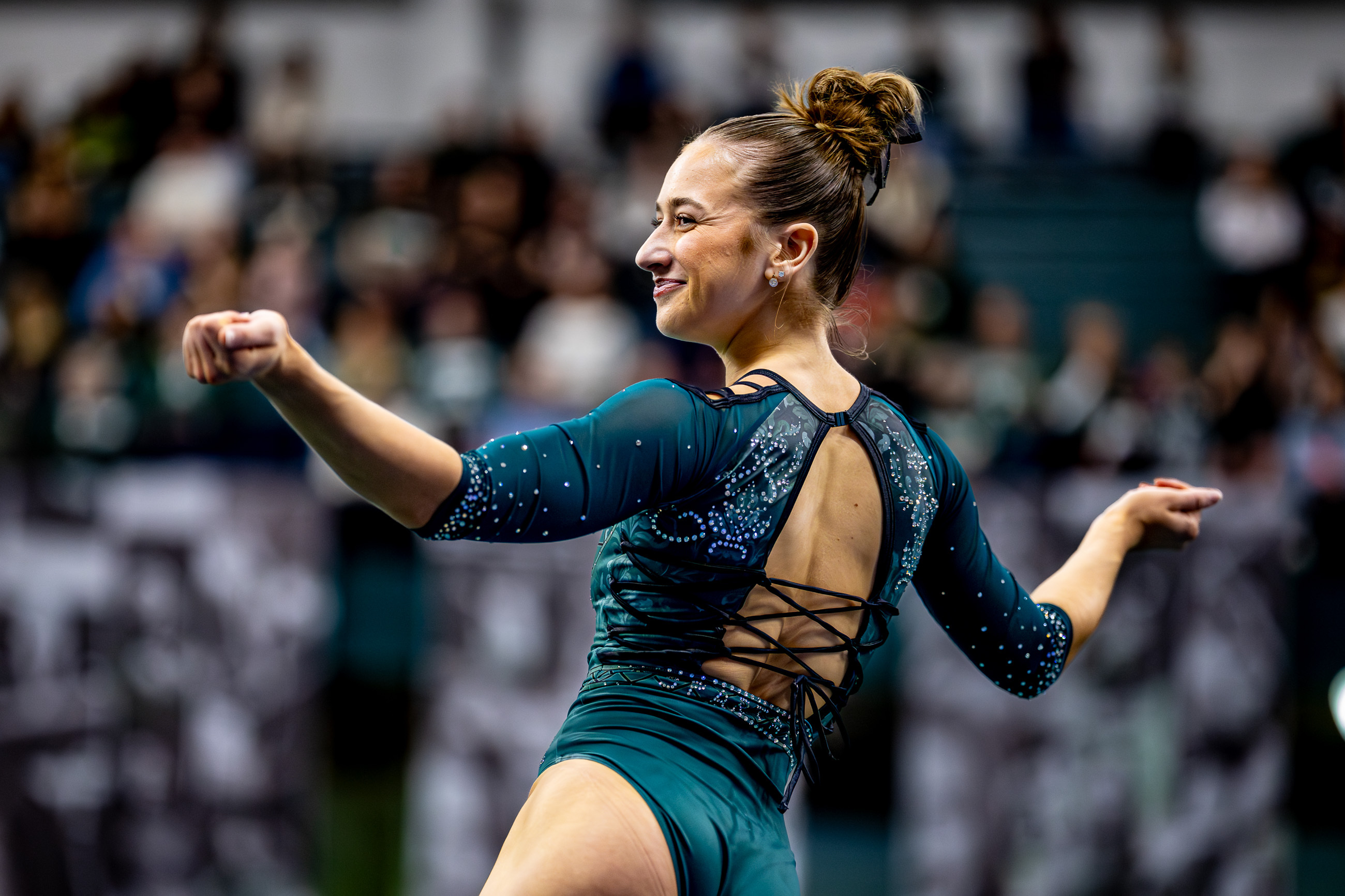 Stephanie Lebster. (Photo credit: Marvin Hall/Spartans Illustrated)
For Lebster, the moment is more than a routine. It is the culmination of something that started long before she ever stepped into a Michigan State lineup, long before she was the one leading things off.
“I’ve been coming to East Lansing literally since I was a baby,” she said. “I’ve got pictures of me here watching gymnastics as a little girl.”
Now she’s the one opening the floor, and for her family, the moment carries even more meaning – because they believed in Michigan State gymnastics long before it looked like this.
Believing early
The Lebster family’s connection to Michigan State spans generations, and for them, this story didn’t begin with recruiting visits or lineup decisions.
Stephanie Lebster’s great-grandfather, Marc Lebster, attended when the school was still Michigan Agricultural College. Gary and Barbara Adelman followed.
Gary has supported Olympic sports at MSU for a long time and made die-hard Spartans of Ryan and his wife, Cathy, who both graduated from Michigan State in the 1990s. Their daughters came next – all four of them attending MSU, with Genna and Stephanie competing for the gymnastics program.
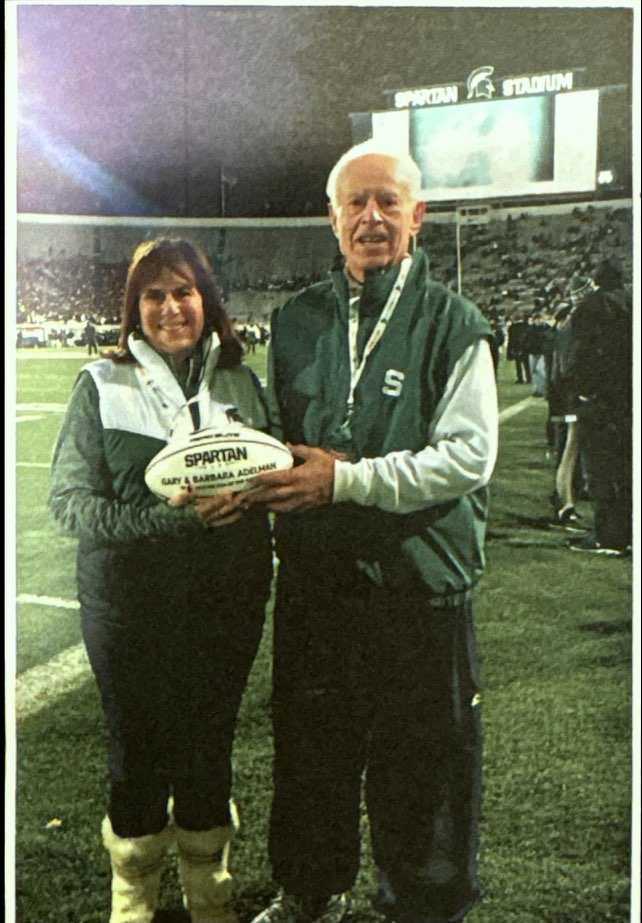 Barbara and Gary Adelman, circa 2014 - Stephanie Lebster's grandparents. (Courtesy photo)
Stephanie, now a senior, is the final Lebster gymnast to wear green and white, closing a chapter that has stretched across years of car rides, competitions, and family milestones tied to the program.
For Ryan and Cathy, the drive from Holland to East Lansing became so familiar that it barely registered anymore.
“It kind of feels like a commute now,” Cathy said.
They weren’t just attending meets. They were watching something take shape in real time, even before most people realized what it could become.
 Genna and Stephanie Lebster, circa 2015. (Courtesy photo)
Finding solid ground again
When the Lebsters first entered the recruiting process, Michigan State gymnastics was in a very different place. The broader athletic department was still navigating the aftermath of a painful chapter that had shaken trust across the university.
The gymnastics program was rebuilding – quietly, steadily – during a period when Michigan State athletics was still working through one of the most difficult moments in its history, and the sport of gymnastics, in particular, carried a heavy shadow.
The program was trying to find solid ground again, both internally and externally.
“When I brought Genna for her official visit, we were ranked around 52nd,” Ryan recalled. (For context, MSU is currently ranked 11th in 2026.)
The difficulties Michigan State was going through, for many families, might have been enough to look elsewhere, especially given the uncertainty surrounding the program at the time. The Lebsters saw something different, something that wasn’t fully visible yet, but felt real.
“We believed in this gymnastics program when nobody did,” Cathy said. “Like, no one did.”
Later she found out that others did as well - including the family of MSU gymnastics legend Skyla Schulte - but the Lebsters were definitely among the early believers in the new coaching staff.
 All four Lebster daughters. (Courtesy photo)
They met the coaches, spent time around the team, and paid attention to how things felt rather than how they looked on paper.
“We felt comfortable right away,” Ryan said. “You could see where it was going.”
Others questioned the decision, asking why they would choose a program that wasn’t yet established at the highest level.
"People asked us, 'Michigan State for gymastics?'" Cathy said. But she never hesitated. “Absolutely. You watch them.”
The builders
What the Lebsters sensed early was a staff committed to building something that would last, even if it took time.
Mike Rowe and Nicole Curler Jones were at the center of that effort, bringing both patience and perspective to a program that needed both. Rowe, a Michigan State graduate who returned after coaching at Pittsburgh, took over as head coach in 2018 and began reshaping the program piece by piece. Jones, a former Spartan gymnast who had qualified for the 2010 NCAA Championships and earned four All-Big Ten honors during her career, had already been part of the program’s foundation for years.
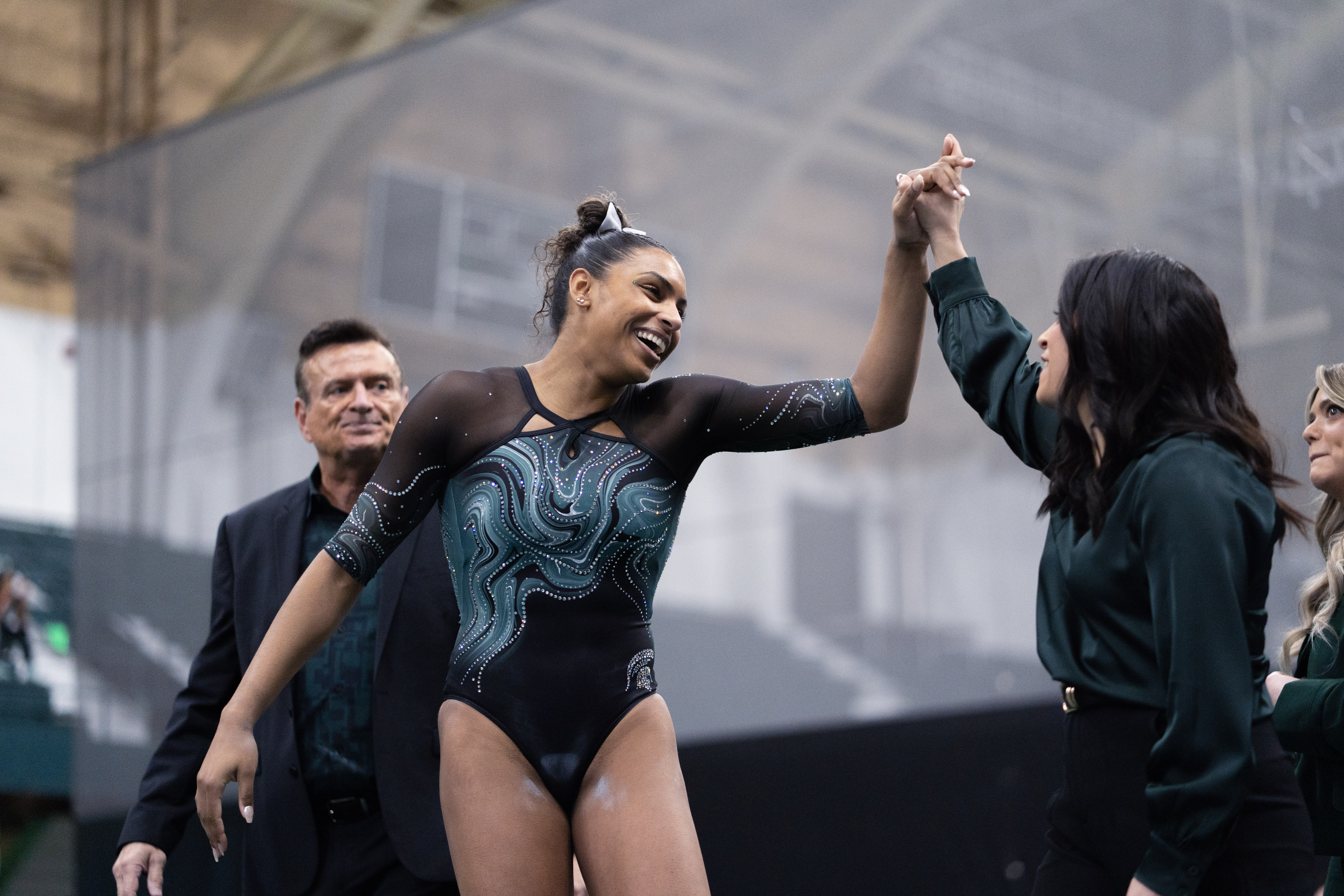 Mike Rowe and Nicole Jones, coaches, with MaKayla Tucker. (Photo credit: Sydney Padgett/Spartans Illustrated)
Together, they approached the rebuild with a willingness to adapt.
“We don’t pretend we know it all,” Rowe said. “We’re constantly asking questions, tweaking our concepts, continuing to raise our own bar along with each of the student-athletes.”
That mindset showed up in the results, but not all at once. It was a progression – a regional appearance, then another, then record scores, then titles – each step building on the last.
Michigan State won its first Big Ten regular-season title in 2023 and followed that with the program’s first Big Ten Championship in 2024, eventually producing All-Americans, perfect 10s, and one of the highest national finishes in school history.
From the outside, it can look like a rapid rise. From the inside, it felt like a long process that finally started to show itself.
“I wholeheartedly agree,” Jones said when told the Lebsters described the climb as a resurrection. “They’ve had a front-row seat to our journey. They’ve watched us rise from the ashes into a highly respected program that now competes for a national championship berth year after year.”
The growth was not just technical or competitive. It didn't just happen on the vault, bars, beam, and floor. It was cultural - and it was intentional.
“We’ve spent a lot of time recruiting kids with great character, not just great gymnastics,” Rowe said. “Integrity, kindness, compassion – the qualities that make them the best version of themselves.”
Jones pointed to the same foundation from another angle.
“The success we’ve had doesn’t come from one single formula,” she said. “It’s consistency in expectations, a team that trusts us because they know we genuinely care, and a relentless work ethic from top to bottom.”
That trust extended beyond the athletes.
“Everyone connected to this program – even our families – has believed in us, lifted us up, and supported us through every high and low,” she said.
More recently, the addition of assistant coach Devin Wright added another layer to that foundation. Since arriving in 2022, Wright has helped elevate Michigan State’s vault and floor lineups to some of the best event scores in program history, bringing a fresh voice and technical precision to a staff that already had deep roots in the program.
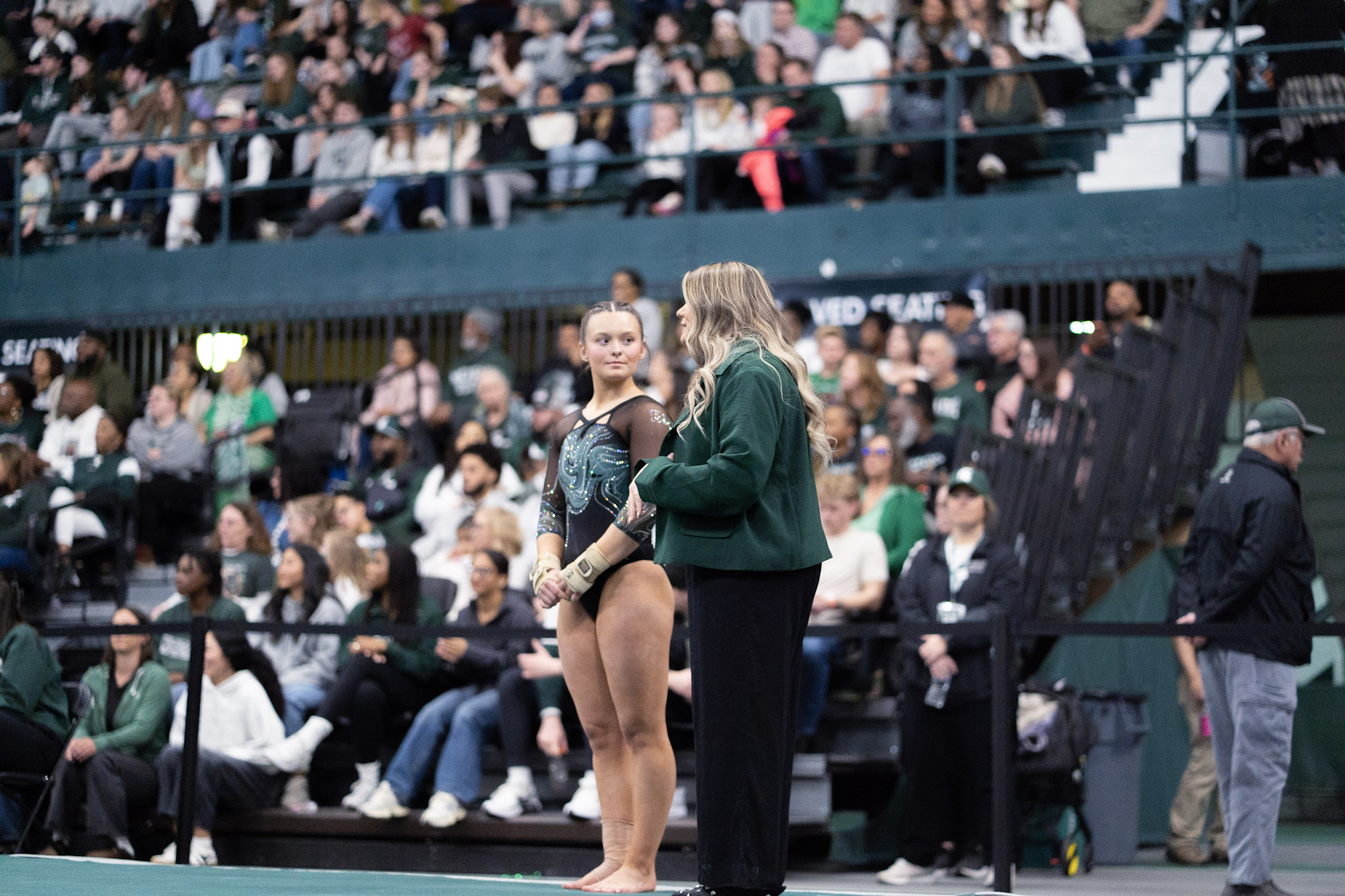 Devin Wright, with Korynne Marquart. (Photo credit: Sydney Padgett/Spartans Illustrated)
A front-row seat
Few families embody that connection more than the Lebsters, and Rowe doesn’t hesitate when describing their role in the program’s growth.
“Ryan and Cathy mean the world to us and our program,” he said. “They’ve been more than active in supporting this program in ways people will never know.”
From the moment their daughters joined the team, the Lebsters didn’t just show up – they invested themselves in the program’s future.
“From the minute Genna came onto the team, they immersed themselves with a genuine interest in what our program goals were,” Rowe said. “They’ve always been supportive with ideas and literally recruiting people to come to our meets, getting people excited about this new age of MSU gymnastics.”
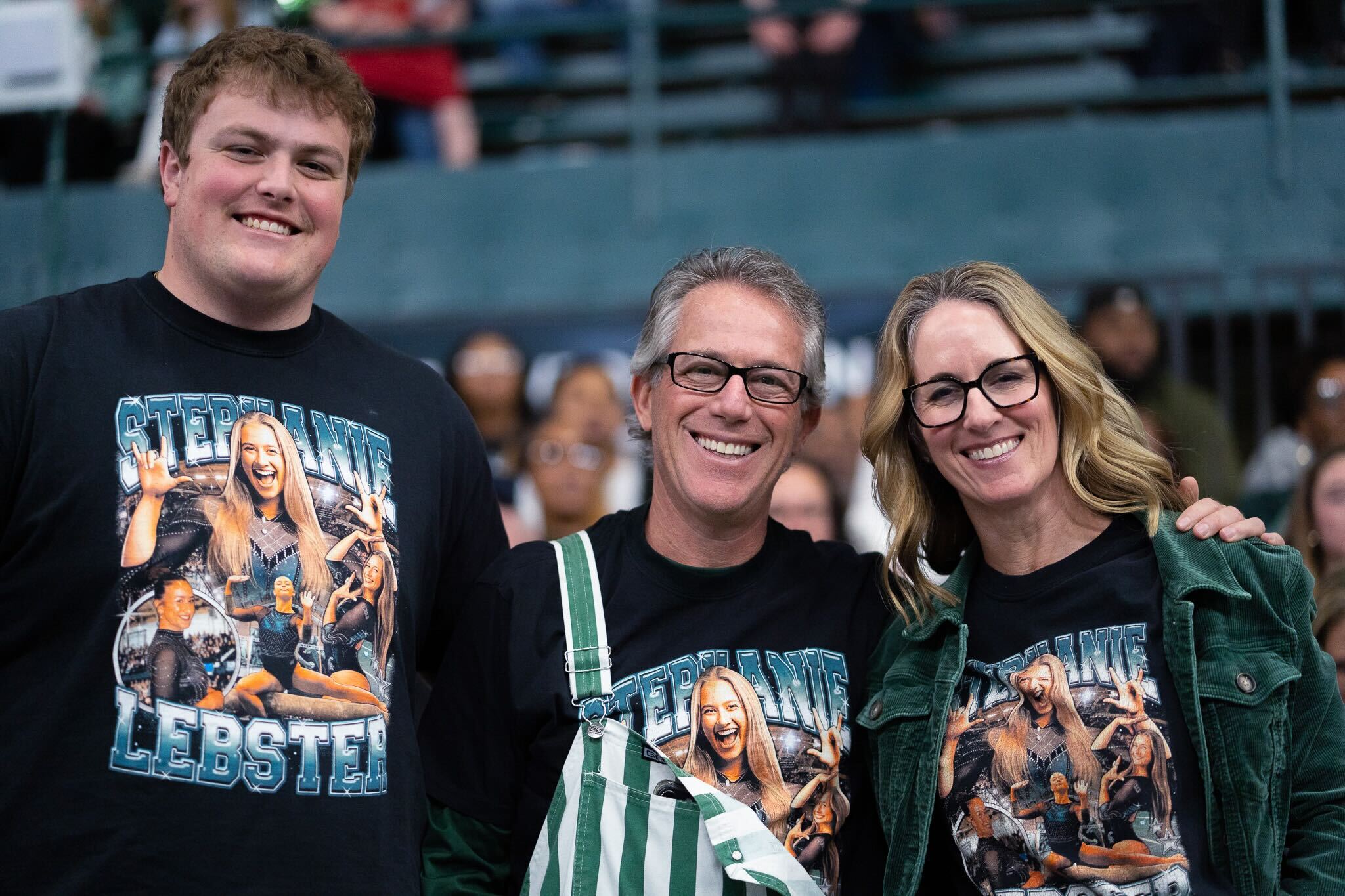 From left to right: Cooper Terpstra (former MSU football center and current boyfriend of Stephanie Lebster), Ryan Lebster, Cathy Lebster. (Photo credit: Sydney Padgett/Spartans Illustrated)
That influence extended beyond their own family.
“Their positive influence has been contagious with our team parents,” Rowe said. “They’ve all come together as a close-knit family that follows us all over the country.”
Jones feels that impact personally as well.
“The Lebster family has been incredible,” she said. “The genuine love and support they’ve poured into our program is unmatched, but even more personally, they’ve consistently believed in me as a coach, a mentor, and a mom. That kind of support means everything.”
Watching it happen
For the Lebsters, the transformation has been something they’ve experienced up close, year after year.
“It’s been huge to watch, just in the last six years,” Cathy said. “I don’t think anybody saw it going this high, this fast.”
Ryan always believed the program could compete at a high level, but even he acknowledges how far it has come.
“Back to back Big Ten champions,” he said. “I knew we’d compete for a Big Ten championship. But back to back?”
Success changed everything, especially in recruiting.
“You get some success and then you can recruit,” Cathy said.
And from there, the climb accelerated.
Stephanie’s moment
Stephanie’s path reflects that same progression.
Her journey to the lineup wasn’t immediate, and it wasn’t easy. She battled injuries, including a broken back and another setback that cost her a season just before competition began, forcing her to wait and fight for her opportunity.
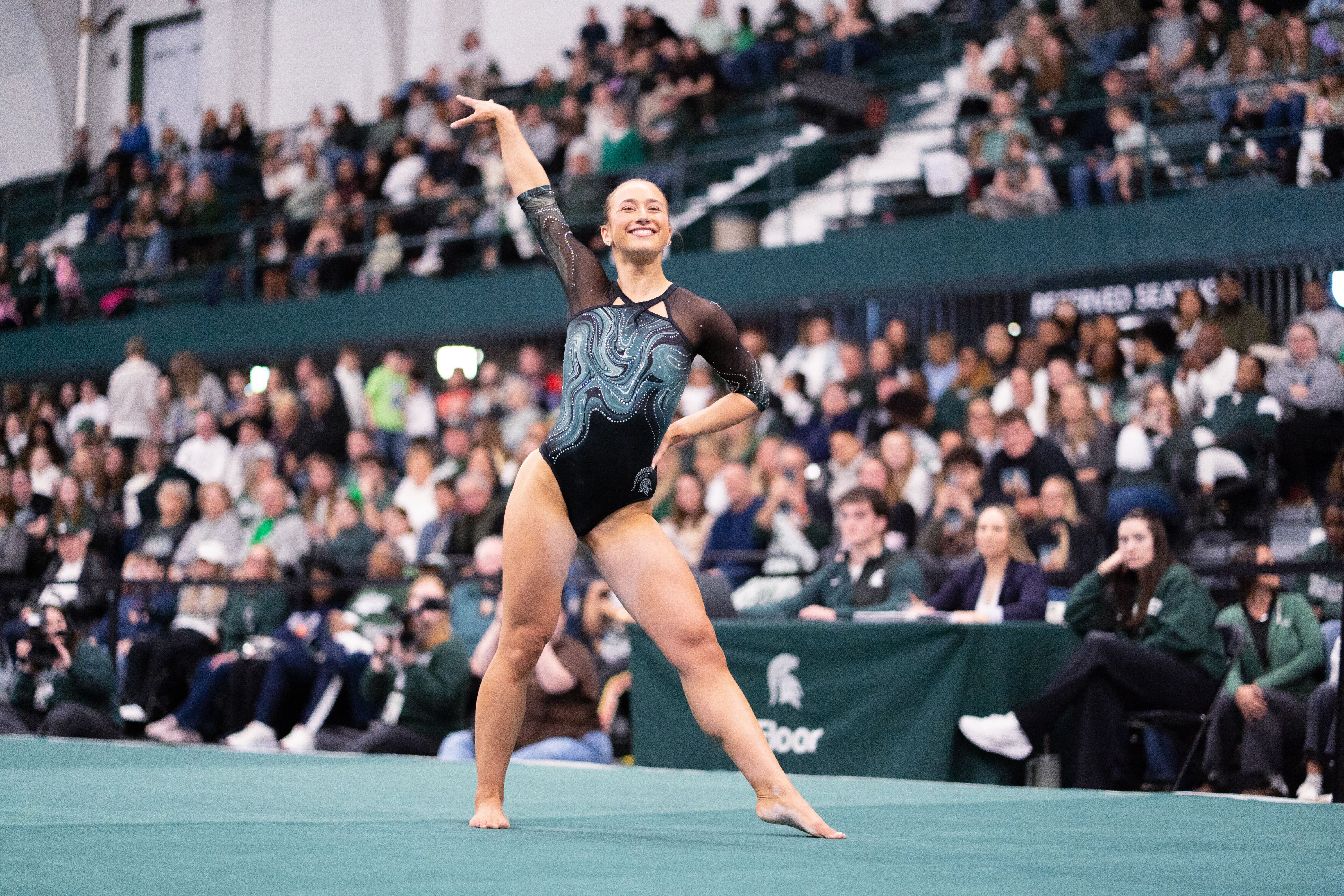 Stephanie Lebster. (Photo credit: Sydney Padgett/Spartans Illustrated)
“It’s been really rewarding,” she said. “I’ve had to persevere through a lot.”
Now she leads off floor, embracing the role in a way that fits her personality.
“I love going first,” she said. “I don’t even have time to get nervous.”
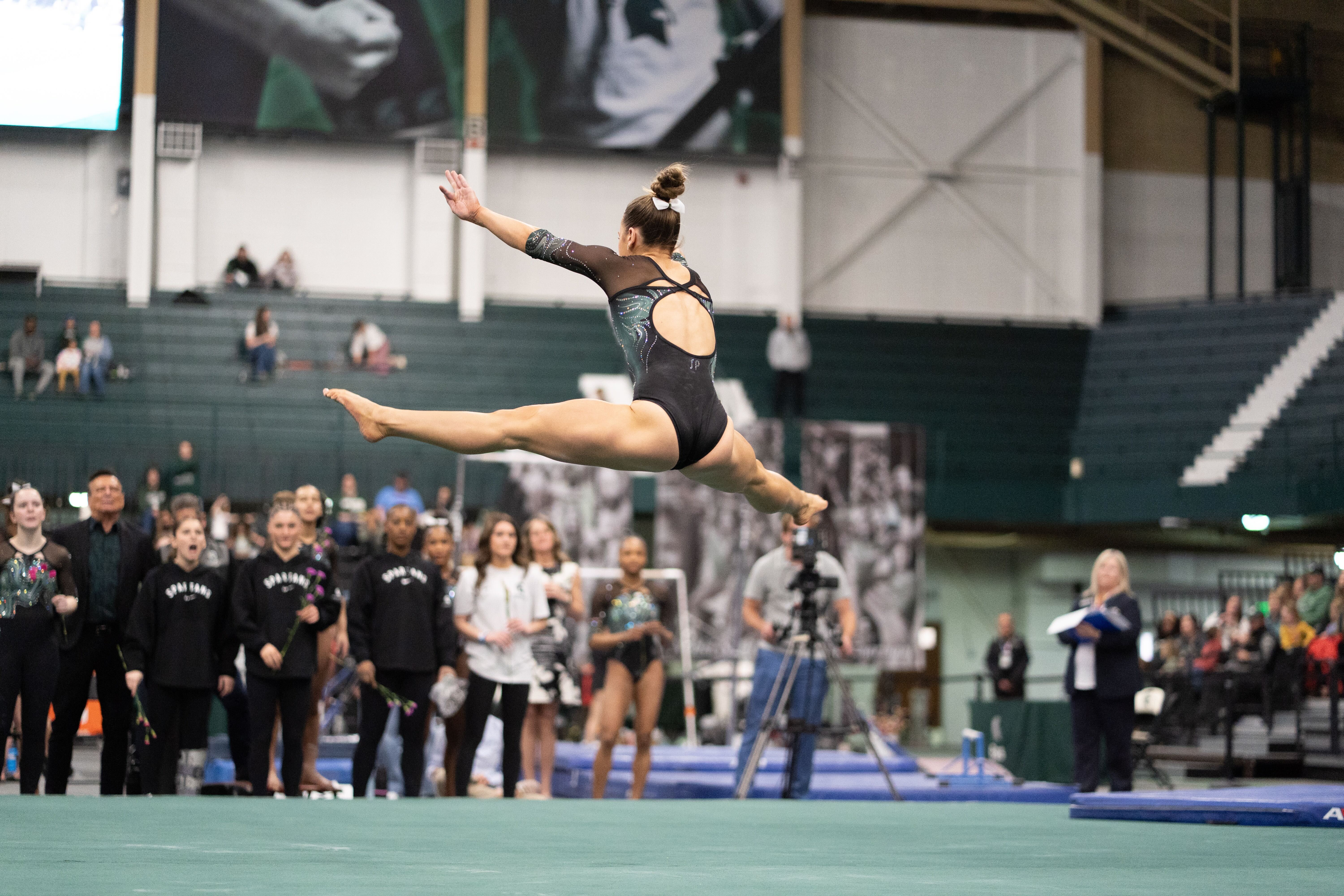 Stephanie Lebster. (Photo credit: Sydney Padgett/Spartans Illustrated)
Once she finishes, she turns into one of the team’s biggest supporters, watching the rest of the lineup with the same energy she once had as a kid in the stands.
More than gymnastics
Her story also reflects something deeper about the program’s identity.
Stephanie is a kinesiology major with a 4.0 GPA and will receive the Michigan State Athletics President’s Award as the top graduating scholar-athlete in the department. She will speak at the annual academic gala this spring, representing the entire athletic department.
For her parents, that achievement matters just as much as anything she has done in competition.
For the coaches, it is part of the goal.
“We want them to bond, celebrate their differences, and accept each other for who they are,” Rowe said. “To grow into the best version of themselves.”
Jones sees that vision playing out every year.
“We bring in athletes who want to be part of something bigger,” she said. “To build a legacy, to grow holistically, and to be valued for who they are, not just the scores they produce.”
The final chapter
When this season ends, it will close a remarkable chapter for the Lebster family.
Two daughters competed for Michigan State gymnastics, and all four attended the university. For years, Ryan and Cathy made the same drive again and again, building their lives around the rhythm of the season.
Soon, that routine will end.
“It’s going to be weird,” Cathy said.
When asked what they are going to do with all their time, Ryan smiled.
“We’re brainstorming.”
What this became
There are moments now – packed crowds, championship banners, national expectations – where the success of Michigan State gymnastics can feel inevitable.
It wasn’t.
It was rebuilt, carefully and intentionally, over time.
“There are definitely ‘heck yes, I believe it’ moments,” Jones said. “But also plenty of pinch-me moments.”
She remembers what the program once was and what it took to get here.
For the Lebsters, the proof looks different.
It looks like a little girl sitting in the stands, watching.
Then growing up.
Then stepping onto the floor.
Then leading the team out.
And behind her, a program that didn’t just return, but rebuilt itself into something stronger than it had ever been before.