Michigan State's path to a Final Four, by the numbers
Dr. Green and White provides a deep dive into the numbers to identify the potential opportunities and pitfalls in the East Regional of the NCAA Tournament
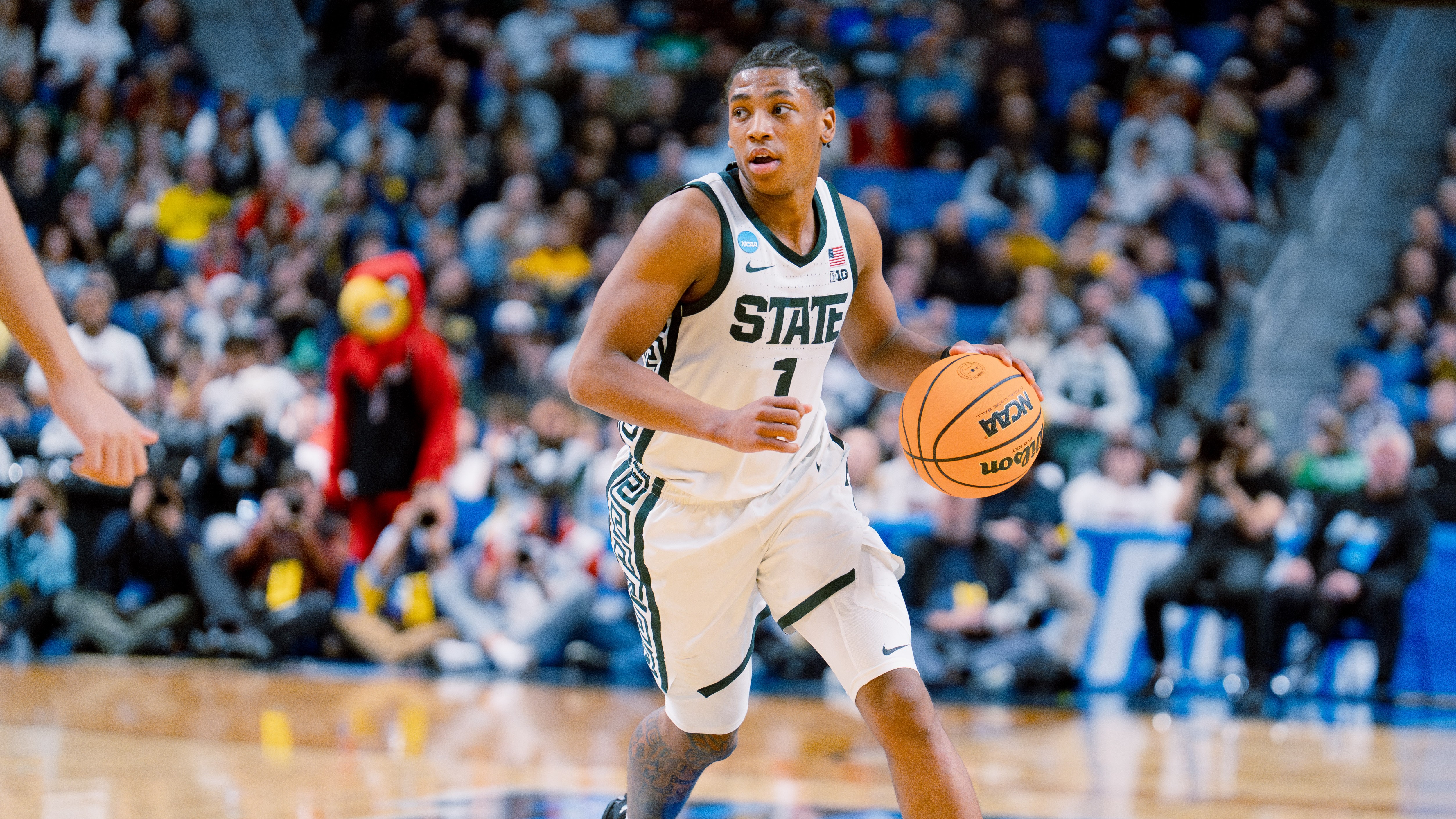
On Friday evening in our nation's capital, two storied programs will meet in the Sweet 16 for the right to advance to the Regional Final on Sunday. The No. 3-seeded Michigan State Spartans will tangle with the No. 2-seeded UConn Huskies.
Sunday will mark the third all-time NCAA Tournament meeting between the Spartans and Huskies. In 2009, Tom Izzo and company defeated UConn in the national semifinal game at Ford Field. It was the only loss that UConn coaching legend Jim Calhoun ever suffered in his three trips to the Final Four.
Five years later, UConn exacted revenge on Michigan State as the No. 7-seeded Huskies overcame a nine-point second-half deficit to upset the Spartans in the 2014 Regional Final. A little over a week later, UConn hosted the National Championship trophy.
UConn is currently a narrow 1.5-point favorite against MSU, which is just barely below the historical average of a two-point spread in No. 2 versus No. 3 seed games in the NCAA Tournament. Based on this spread, the Huskies have about a 56% chance to defeat the Spartans.
But what are the relative strengths and weaknesses of each team? Where can the Spartans expect to carve out an advantage and where do they need to take particular care? Let's take a closer look at the two teams as well as the other two teams in the East Region (Duke and St. John's) from the view point of the four factors of basketball success and tempo adjusted efficiency.
Overall Efficiency
Figure 1 below provides a visual summary of the adjusted offensive and defensive efficiencies for the four remaining teams in the East Region of the 2026 NCAA Tournament. These values are tabulated by Ken Pomeroy and were as of the Monday following Selection Sunday. For reference, the efficiencies of each Big Ten team are also plotted.
 |
Figure 1: Pre-NCAA Tournament Kenpom adjusted offensive and defensive efficiencies for the four remaining teams in the 2026 East Region as well as the members of the Big Ten. |
For the four teams competing this weekend in Washington D.C., the data point labels also contain the numerical ranking for each team both on offense (the first number) and defense (the second number).
For example, Michigan State ranked as the No. 24 team on offense and the No. 13 team on defense as of March 16.
The overall Kenpom efficiency margin (which can be used to accurately project point spreads) is defined as the difference between offensive and defensive efficiency. Graphically, the efficiency margins increases diagonally from the lower left-hand corner of the graph to the upper right-hand corner.
As Figure 1 shows, Duke is the most efficient team remaining in the East Region. This is not a surprise considering that the Blue Devils ended the regular season as the top team in Kenpom efficiency margin and earned the No. 1 overall seed in the Big Dance.
Also note that the Michigan Wolverines have an efficiency profile that is almost identical to that of Duke.
As for the rest of the East Region participants, Michigan State, UConn, and St. John's are all clustered together in a very similar region of the graph. The three schools have virtually identical defensive efficiencies which rank No. 11 (UConn), No. 12 (St. John's), and No. 13 (Michigan State) in the country.
The primary difference between the three schools is that the Spartans grade out with the best offense (No. 24). UConn is next with an offensive rank of No. 29 while St. John's checks in with the weakest offense in the region at No. 44.
Overall, MSU (No. 9) has a slight edge in efficiency margin over UConn (No. 10) and St. John's (No. 17). Based on Kenpom, Michigan State should be a very slight favorite (-0.3) to beat UConn on Friday night. MSU also projects to be 1.5-point favorite over St. John's and a seven-point underdog versus Duke.
For reference, both UConn and St. John's most resemble Big Ten foe Nebraska in regards to offensive and defensive efficiency.
Shooting
Now let us dive a little deeper in the data to understand the relative strengths and weaknesses of each team through the lens of the four factors of basketball success which are shooting, turnovers, rebounding, and free throw rate.
Figure 2 below summarizes the shooting prowess of the same group of 21 teams highlighted in Figure 1. The effective field goal percentage for each team is plotted on the x-axis while the defensive effective field goal percentage allowed is plotted on the y-axis.