
Against All Odds, 2025 Week Six: 99 Luftballons
There is no reason to go nuclear. Things are not as bad as they seem.
I learned something new this weekend about Big Ten traditions.
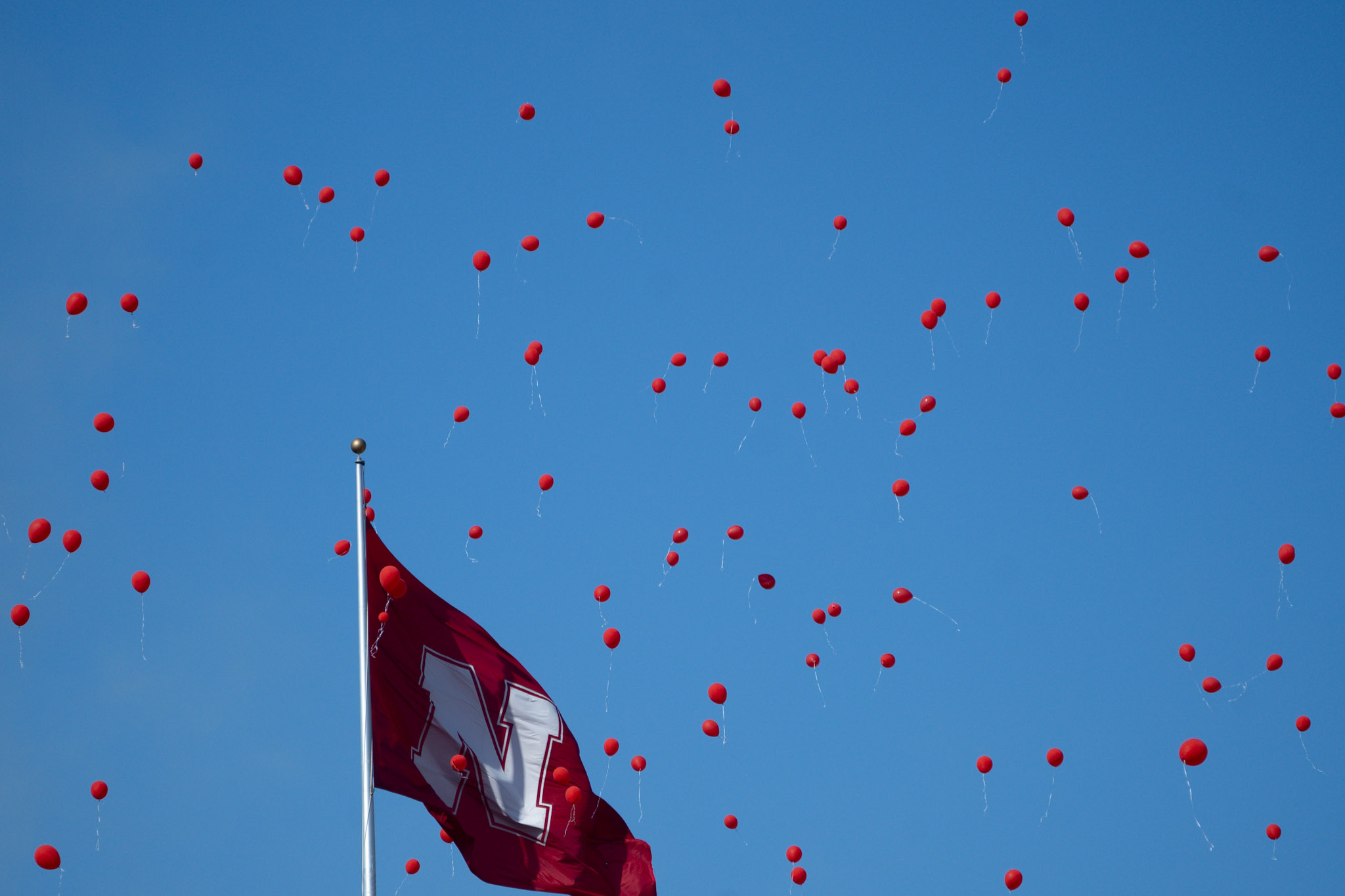
Fans of the University of Nebraska historically release a series of red balloons after the first touchdown is scored at a home football game. My internet research tells me that this tradition started in the 1960s and was suspended in 2022 due to concerns over the environmental impact and global helium shortages.
The tradition was partially brough back in 2024 for special occasions such as this weekend's homecoming game against Michigan State. A release of said red balloons was visible on the television broadcast following the score in the first quarter of the Cornhuskers' 38-27 win over the Michigan State Spartans. Spartans Illustrated photographer and contributor Sydney Padgett caught the release on "film:"
Because I grew up in the 1980s, the sight of a large number of red balloons immediately made me think of this:
A little bit more internet research reminded me that the ballad "99 Luftballons" by the West German band Nena is actually a cautionary tale about the dangers of overreaction.
The lyrics tell the story of a pair children who set free a bag of balloons at the break of dawn into the summer sky. The military sees the balloons and mistakes them for some sort of foreign attack. In classic cold war era style, four verses later it's World War III.
In the aftermath of the Spartans' loss, some fans seemed to go nuclear as well. There were rumblings from some corners of the fanbase about whether Jonathan Smith should be fired. Some suggested that this team is worse than last year's 5-7 team. Fans were seeing red and melting down.
While the loss was certainly frustrating, I still saw signs of progress in Lincoln this weekend. I am hear to tell you that the situation is not nearly as bad as some think.
Michigan State is currently 3-2 and ranked No. 55 in my latest power ranking. If I look back my preseason analysis, the Spartans were ranked No. 58. The expected number of wins after three games was 2.88.
In the preseason, I predicted that the Spartans would be a 14-point underdog at USC and a 12.5-point underdog at Nebraska. Michigan State lost those two games by 14 and 11 points respectively. The Spartans beat both actual spreads by a few points. The Michigan State season is essentially proceeding exactly the way the preseason projections suggested was most likely.
As for the game itself, Michigan State showed some spark on defense. For the first time in a while, the Spartans generated a pass rush and were able to disrupt the Cornhusker offense. The Spartans were the better team for large sections of that game.
Obviously, those bright spots were overshadowed by several other issues. Michigan State gave away at least 10 points on special teams gaffes. The Spartans struggled to run the ball, and Aidan Chiles was clearly not himself, especially later in the game. It is hard to win games with this list of problems. But most of those problem are correctable.
The type of frustration felt by Spartan fans is the frustration felt when a team could or maybe even should have won a game, but didn't.
This is significantly different than the frustration felt when a team is completely uncompetitive and gets beaten by more than 20 points, as was the case in five of the seven losses last season. Keep in mind that Michigan State lost to Rutgers last year, at home, by 27 points with a possible bowl bid on the line.
Yes, this type of frustration is different. It might not feel like it, but it is a form of progress. And, that is not just a bunch of hot air.
Week Six Betting Results
Let's now take a look at the performance of last week's picks from my Bad Betting Advice article, starting with the overview summary shown below in Figure 1. More information about how to read this figure can be found in the Week One edition of Against All Odds.

Figure 1: Results of Week Six showing the actual point differentials relative to the opening spread.
A total of nine teams qualified overachieved by beating the spread by more than 14 points: Pittsburgh, UConn, Old Dominion, Memphis, Northwestern, Duke, Ohio State, Clemson, and San Diego State. For the second weekend in a row no teams which failed to cover the spread by 14 points, yet won.
But a total of 12 teams lost in upset fashion, which was right in line with my simulation's prediction of 12.6 from last week. Table 1 below summarizes those upsets and compares them to the picks made last week.
Table 1: Upsets in Week Six based on the opening Vegas line compared to the upset projections from last week.

The biggest upset of the week and the season so far was Penn State's loss at UCLA (+26). An upset of this magnitude only occurs about once per season, on average. The Group of Five also had two upsets of teams favored by double digits: Ball State over Ohio (-17) and Arkansas State over Texas State (-10.5).
Other notable upsets include Virginia over Louisville (-7), Florida over Texas (-6.5), and Wake Forest over Virginia Tech (-5.5).
My algorithm's performance on upsets was a big deflating this week. It went only 2-7 (22%) which brings the year to-date-performance down to 20-20 (50%). ESPN's FPI went 0-1 (0%), bringing its year-to-date tally to 10-21 (32%).
Table 2 below gives the results of the computers' picks against the opening spread.
Table 2: Results of the highlighted picks against the spread for Week Six.

The performance here was more uplifting as my algorithm went 4-3 (57%) which brings the year-to-date performance up to 17-13 (57%). My analysis of the FPI data resulted in no recommended picks against the spread.
Considering all 50 games in Week Six, my computer went 26-24 (52%) against the opening spread, bringing the year-to-date total to 139-157 (47%). The FPI performed a bit worse, going just 21-29 (42%) against the spread. This brings the year-to-date performance down to 144-152 (49%).
Table 3 below gives the results of the point total bets for Week Six.
Table 3: Results of the recommended point total bets ("over/under") for Week Six.

My point total bets had a strong week. The lock picks went a perfect 2-0 and the full list of recommended picks went 8-5 (62%).
Year-to-date, the locks are still just floating along under .500 at 12-13 (48%) while the full set of recommended bets are 61-68 (47%).
Updated Big Ten Odds and Expected Wins
Following the results of Week Six, I have re-run the full season Monte Carlo simulation using the updated power rankings, including the current uncertainty in those rankings, to update the season odds for each team.
Table 4 below gives the update for the Big Ten conference and Table 5 shows the updated Big Ten win distribution matrix.
Note that all the rankings listed in the table and mentioned below refer to my computer's power rankings and not any of the national polls.