ANALYSIS: Michigan State has the defense of a national title team - now the offense must catch up
DEEP DIVE: Michigan State already looks like a championship team defensively. Whether the Spartans can raise their offensive efficiency - through pace, role clarity, and half-court execution - will determine how far this season can go.
Every March, the numbers tell a familiar story: national champions almost always pair an elite defense with a high-end offense. Michigan State already checks one of those boxes emphatically. Whether it can check the other will determine just how far this season can go.
Since Ken Pomeroy began tracking efficiency in 1997, the championship profile has been remarkably consistent. True title contenders almost always feature a top-15 defense and a top-10 offense. Only three champions have broken the defensive rule: Kansas in 2022 (#17), Baylor in 2021 (#21), and North Carolina in 2009 (#18). Offensively, the exceptions are slightly more common but still rare: Arizona in 1997 (#11), Syracuse in 2003 (#17), UConn in 2011 (#19), and UConn in 2014 (#39) are the only champions outside the top 10.
Michigan State enters the heart of the season at 10–1 (2–0 Big Ten), with its lone loss a six-point home defeat to a very good Duke team. Tom Izzo’s group is firmly in the national conversation, ranking No. 12 in KenPom, No. 10 in BartTorvik, No. 13 in EvanMiya, and No. 9 in both the AP and Coaches Polls.
Defensively, the Spartans already look like a championship-caliber team, sitting No. 4 nationally in KenPom defensive efficiency and clearly among the country’s elite. The remaining question is offense: Michigan State is still searching for consistency on that end, currently ranked No. 46 in KenPom’s offensive ratings. Whether that number climbs may ultimately decide the Spartans’ ceiling.
In terms of broader benchmarks, Michigan State checks many of the traditional boxes for a championship-caliber team. The Spartans have one of the elite head coaches and coaching staffs in the sport, an outstanding point guard in Jeremy Fears, and a roster anchored by veteran leadership. Perhaps the most encouraging early-season development has been the regression of the team’s three-point shooting toward its true mean - that is, the level suggested by its underlying shooting talent. Michigan State is now shooting 36.5 percent from three, the 75th-best mark nationally.
While the overall attempt rate remains modest - only about one-third of the Spartans’ shots come from beyond the arc - the offense continues to excel at ball movement, posting a 69.8 percent assist rate that ranks fourth nationally. Just as importantly, this group has reestablished Michigan State’s historical dominance on the glass, with a No. 9 offensive rebounding rate (41 percent of available offensive rebounds) and a No. 4 defensive rebounding rate (allowing just 23.1 percent of available defensive rebounds).
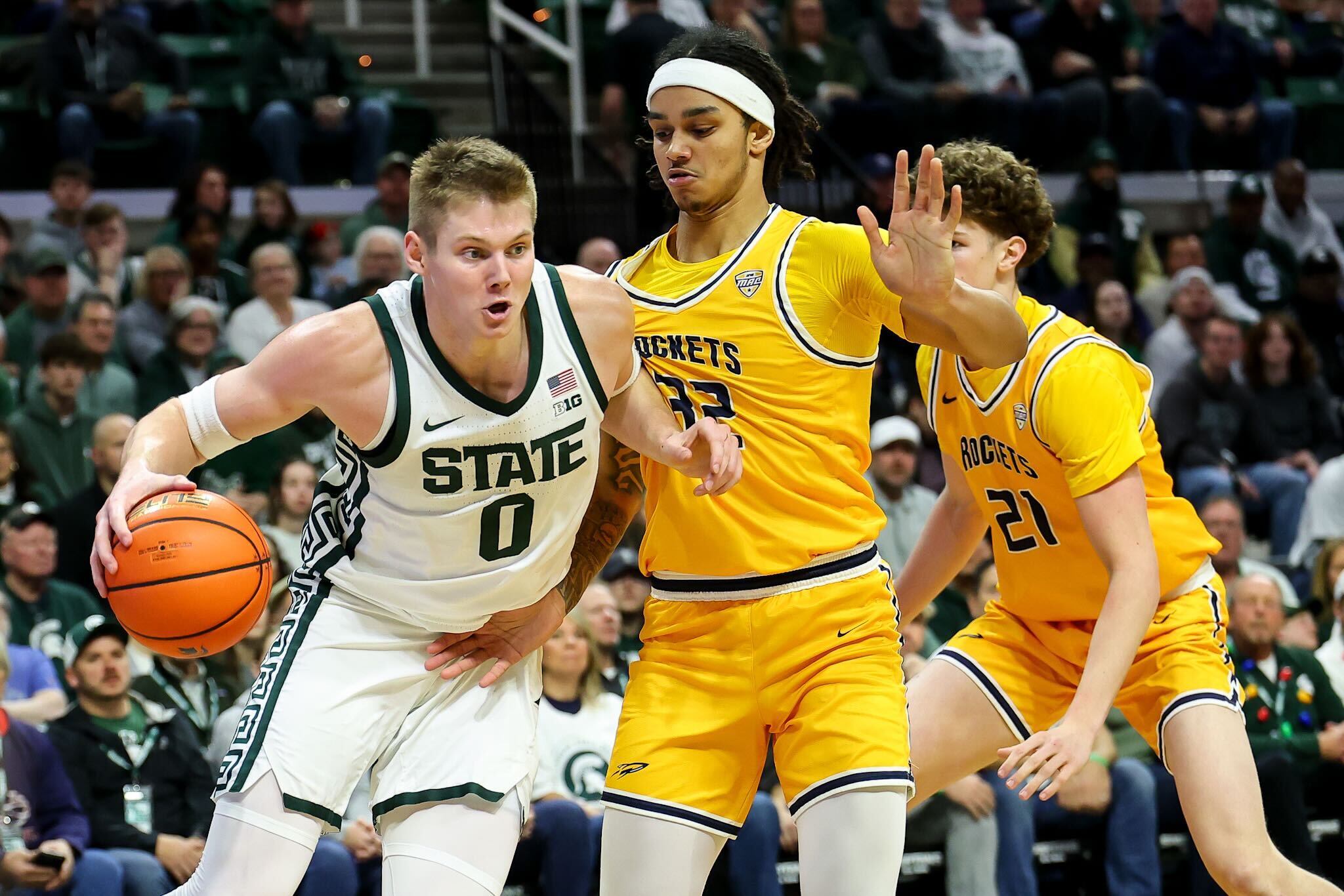 Photo credit: Marvin Hall/Spartans Illustrated
The primary hurdle that remains is scoring efficiency. Jeremy Fears continues to profile as one of the five best point guards in the country, and his passing, feel, and control of the offense have been excellent and are still improving. Even so, the Spartans must find ways to generate more efficient offense on a possession-by-possession basis. That effort needs to begin in transition. Earlier in the season, Michigan State played several higher-possession games - Colgate (69 possessions), Arkansas (68), Kentucky (71), and ECU (72) - but the pace has slowed significantly over the past four contests.
This team has shown it can win both fast- and slow-paced, high-leverage games. The concern, however, is that against top-15 opponents in KenPom’s ratings, slowing the game down tends to magnify Michigan State’s half-court offensive limitations, where clean scoring opportunities are harder to create.
This roster is not built around elite one-on-one scorers. Cam Ward and Jaxon Kohler are probably the Spartans’ best isolation options from a pure talent standpoint - though Jeremy Fears has also made real strides in that area, even if it is not yet his natural comfort zone. That reality underscores a central truth about this team: isolation scoring is not a strength.
Subscribe to Spartans Illustrated to continue reading this article.