
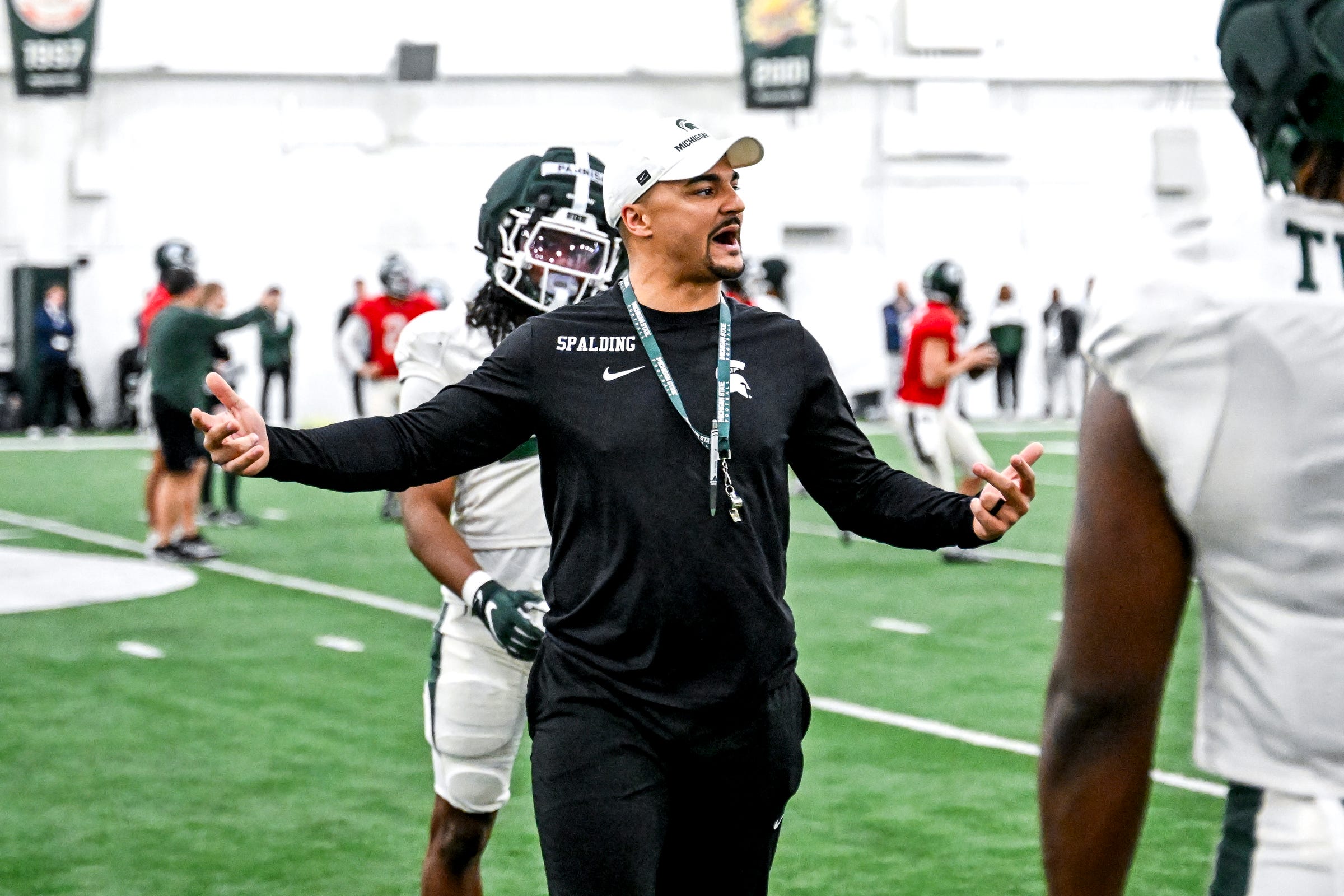
Back home, Devon Spalding is building Michigan State’s running back identity
His playing career and coaching climb are now guiding a physical, disciplined approach to the position
There’s a moment in every coach’s career when the path narrows.
For Devon Spalding, it didn’t come with a title change or a formal pivot point that everyone around him could see. It came after a phone call and a broken ankle.
He always knew he wanted to coach. That part, he said, was never really in doubt. The only real question was when.
At the time, he was still holding onto football as a player, weighing whether there was something more there for him beyond college, still trying to figure out how long that path might extend. Then, in the last game he played, he broke his ankle. Around that same stretch, his former position coach – Gino Guidugli – reached out after taking a job at Cincinnati and told Spalding there was an opening on staff.
It wasn’t an automatic answer. Spalding went home, sat down with his family, and took a few days to think it through, to talk it out, to pray on it. Three days later, he called back and accepted.
“That’s when (my) career took off from there,” he said.
The path since then has been steady and upward, moving from a graduate assistant role at Cincinnati in 2019 into a full-time position at Youngstown State, where he spent three seasons developing one of the most productive rushing attacks in the country, including working with record-setting back Jaleel McLaughlin, before making the jump to Wisconsin.
Over three seasons in Madison, his backs produced at a high level in the Big Ten, including multiple all-conference selections, and he built a reputation as a young coach who understood both the demands of the position and the realities of the league.
Now that path has led him back home – to Michigan State - to a state he knows well, and to a position room that is still taking shape but already has a clear identity.
A Canton native who once ran for 1,761 yards and 27 touchdowns as a senior at John Glenn High School – including a 491-yard game that still stands among the highest single-game totals in MHSAA history – Spalding understands what football looks like in this state because he’s lived it, not just as a coach passing through, but as someone who came up in it and now finds himself recruiting it again.
Before his coaching career began, Spalding spent five seasons at Central Michigan, where he played both running back and wide receiver and developed into a multi-year contributor. He started 10 games at running back during the 2016 season, finished his career with more than 1,400 rushing yards and 13 touchdowns, and earned the program’s Dustin Preston Leadership Award as a senior, a reflection of how he was viewed inside the locker room.
He also knows what Michigan State looks like from the other side. Spalding said he played two games in Spartan Stadium during his college career, and later returned as a coach while at Youngstown State, experiences that gave him a firsthand feel for the environment he’s now a part of every day.
That perspective shows up quickly when he starts talking about the position he coaches.