
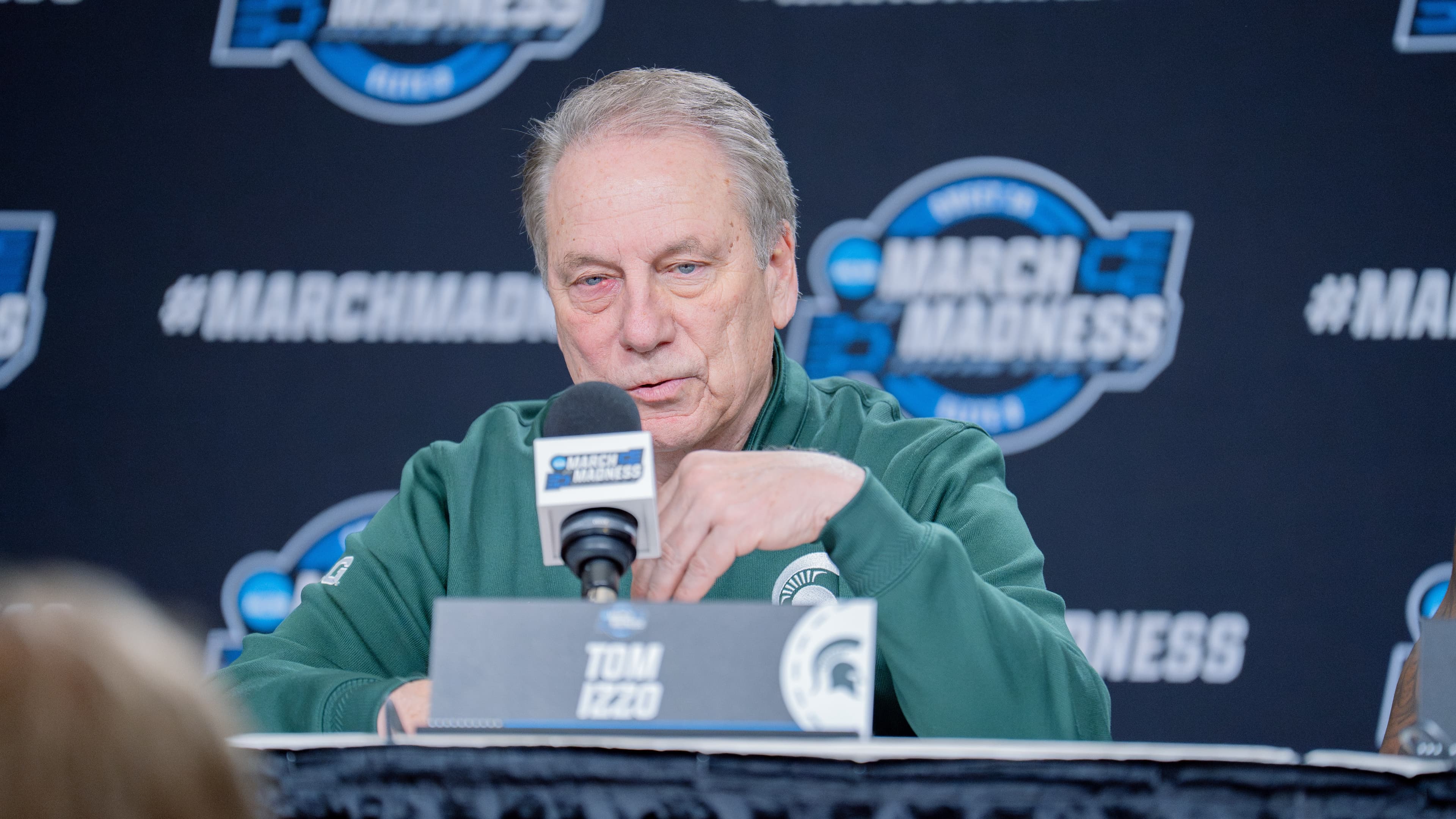
Tom Izzo Retrospective, Part Three: Advanced NCAA Tournament Performance Metrics
There are several advanced ways to measure NCAA Tournament performance, especially relative to expectation
In the first two parts of this series we have taken a look at Michigan State head coach Tom Izzo's accomplishments in the Big Ten and in key March Madness performance measures such as total wins, Sweet 16s, Final Fours, wins as the lower seed, and wins on a two-day prep.
The data presented clearly demonstrates Izzo's historical dominance. But as mentioned previously, not all NCAA Tournament paths are created equally. Fortunately, there are more advanced ways to level the playing field by looking at metrics that measure performance compared to expectation.
In total, there are five performance-versus-expectation metrics that I tabulate for the NCAA Tournament. Two of these metrics are commonly used by others, two of them I created myself, and one is a simple accounting stat.
PASE (performance against seed expectation):
PASE is the "original" advanced NCAA Tournament metric. It measures the number of wins for each coach or team relative to the historical total number of wins per tournament for teams with a given seed. For example, No. 1 seeds have historically won 3.34 games per tournament since 1985. In order for a No. 1 seed to overachieve with a positive PASE score, they need to win four games and advance at least to the Final Four.
PARIS (performance against round-independent seed):
PARIS is a metric that I created that measures almost the same thing as PASE. The difference is that I consider the historical win percentage for each seed in each round separately and not for the tournament as a whole.
PAD (performance against exact seed differential):
PAD is a variation on PARIS that I created which takes into account the seed of the opponent for each tournament game. For example, playing a No. 15 seed in the second round is quite a bit easier than facing a No. 2 seed. PAD accounts for this difference, while PASE and PARIS do not.
PAKE (performance against Kenpom expectation):
PAKE is the other commonly-used metric that is similar to my PAD metric. PAKE accounts for the true strength of each opponent in each tournament game, regardless of seed, based on Kenpom efficiencies. However, reliable Kenpom data - and therefore this metric - only goes back in time as far as 2002.
Chalk (+/-)
This is a simple accounting stat that measures the total number of games won by a coach or team relative to the situation where the higher seeds win all tournament games up to the Final Four rounds. Chalk and PASE give similar information.
In order to get a sense of the range and distribution of the PASE metric, Figure 1 gives the current PASE score for all 720 coaches who have appeared in an NCAA Tournament game since 1979 sorted from high to low.
 |
Figure 1: PASE metric for all NCAA Tournament coaches from 1979 through 2026 |
The values range from +17.10 down to -8.58. Moreover, note that the highest data point are the far left of the figure sticks up considerably farther than even the second place coach.
That data point at the far left belongs to Tom Izzo.
Izzo's current PASE value of +17.10 is a full 4.54 points ahead of the coach in second place (Louisville legend Denny Crum) and 5.57 points ahead of Rick Pitino (who has coached at Providence, Kentucky, Louisville, and Saint John's) the active coach with the next highest score.
Izzo's current score is not only the top score of 2026. It is also the highest score recorded by any coach at any point in the history of the NCAA Tournament. Duke legend Mike Krzyewski had a PASE of +16.05 following his National Championship in 2001 but retired after the 2022 season with a PASE of +11.63.
Crum maxed out in 1998 with a PASE of +14.33. Pitino's PASE has been as high as +13.68 after the 2015 season. John Calipari reached a maximum of +11.49 in 2019 and Roy Williams was at +11.29 after winning a title in 2017. Billy Donovan had a PASE of +10.58 in 2014 before moving on to the NBA.
Villanova legend Rollie Massimino has a PASE of +10.76 in 1989 and John Beilein had his PASE as high as +10.87 in 2018. Former Michigan coach Steve Fisher had a PASE of +10.09 in 1994 with a team full of ineligible players. No other coach in history has topped a PASE of +10 at any point in their career.
The story is the same for most of the other metrics. Tom Izzo also owns the all-time best score in my PARIS metric (+9.89), PAD metric (+9.86) as well as the Chalk metric (+14). The only other coach in history with a double-digit Chalk score is Massimino (+12). The next highest active coaches are UConn's Danny Hurley and Oregon's Dana Altman with +7.
The only metric where Izzo does not currently own first place is the PAKE metric. Izzo's PAKE of +5.83 is currently third place behind Syracuse's Jim Boeheim (+6.79) and Roy Williams (+6.26). The next highest active coach is Hurley at +5.01.
But keep in mind that my tabulated PAKE only goes back to 2002. So even when Izzo's national title and first three Final Fours are not considered, he is still in the top three all time for performance relative to Kenpom efficiency.
Beyond simply the raw numbers, the metrics can be compared in unique ways.
For example, the PARIS and PAD metrics have certain mathematical properties which allow us to extract some additional interesting information. Specifically, the PARIS metric compares performance per round to the historically average performance for every team of the same seed in that round. The PAD metric is very similar, but it references the specific seed of each opponent and is therefore a more accurate measure of the true difficultly of each tournament game
Because of this difference, when each team's PAD score is subtracted from its PARIS score, the value represents the amount of "luck" that a team or coach has had in the opponents that they have faced relative to average. Positive luck means that coach has drawn an easier than average set of tournament paths.
This effect is best shown below in Figure 2.
 |
Figure 2: Comparison of NCAA Tournament luck (as measured by the difference between PARIS and PAD) and true NCAA tournament performance relative to expectation (PAD). |
Figure 2 compares the "luck score" (PAD subtracted from PARIS) to the PAD metric, which is indicative of the "true" performance versus expectation in NCAA Tournament play. Figure 1 includes data from all 720 head coaches who have appeared on the sidelines of at least one NCAA Tournament game.
The vast majority of these data points are clustered near the origin. However, several notable coaches appear in the area outside of this middle region. Each coach's position on the graph gives information about the relative impact of "luck" on their tournament performance relative to expectation.
The upper right-hand corner of the graph highlights coaches with both positive PAD and luck. In other words, on average, these coaches have been both lucky and good. Most notable in this section of the graph are Krzyzewski, Beilein, Boeheim, UConn's Jim Calhoun, Dusty May and the all-time king of NCAA Tournament luck, former Florida coach Bill Donovan.
Donovan's example helps to illustrate the meaning of the luck metric. A No. 15 seed has defeated a No. 2 seed in the first round a total of 11 times in Tournament history. Naturally, this upset will usually favor the remaining teams in that half of the bracket, as the nominally "strong" No. 2 seed has been eliminated.
While at Florida, Billy Donovan benefited from this type of upset of a No.2 seed in both the 2012 tournament (as a No. 7 seed) and in the 2013 tournament (as a No. 3 seed).
While Donovan certainly enjoyed a lot of tournament success, his performance relative to expectation was certainly padded later in his career due to some fortunate upsets in his part of the bracket. Similarly, Krzyewski, Beilein, and Boeheim have been similarly "lucky" compared to the average NCAA Tournament coach.
The lower right-hand corner of the graph is home to coaches who have been successful relative to expectation despite some below-average tournament luck. The notable coaches here are Roy Williams, Maryland's Gary Williams, Sean Miller, Rick Majerus, Chris Beard and Rollie Massimino.
Tom Izzo's position in Figure 2 is relatively unique. Not only is his PAD score significantly larger than any other coach in history, Izzo also accomplished accomplished this feat with historically average luck.
Figure 2 also identifies the most unlucky coach as all time, Arizona's Lute Olson. He had his share of big wins and terrible losses, but in a total of 73 tournament games, Olson only faced six opponents which were more than one seed line below the "chalk" value for that round.
By comparison, Donovan faced 15 opponents more than one seed line below the "chalk" value in just 47 NCAA Tournament games. Dusty May already has three such opponents in just 15 total games.
The upper left-hand side of the figure displays coaches who have had below average performance relative to expectation, but who have been a bit lucky with their tournament draws. The notable coaches here are Bob Huggins and Bill Self.
Figure 2 also highlights some of the biggest underachievers in tournament history on the far left side of the graph. Virginia's Tony Bennett has the third lowest PAD (-4.22) and second lowest PASE (-8.50) on record, but he was slightly lucky on balance.
Rick Barnes (PAD of -4.81), Gene Keady (-4.21), and Jamie Dixon (-3.35) are the other notable coaches who historically bring up the rear in tournament performance relative to expectation.
For the final comparison for today, Figure 3 compares the PAKE metric to the PAD metric, as calculated since 2002.
 |
Figure 3: Comparison of the PAKE metric to the PAD metric since 2002 for all NCAA Tournament coaches. |
As expected, these two metrics are closely correlated. Both metrics are attempting to measure the number of actual wins compared to the number of expected tournament wins.
PAKE measures expected tournament wins based on the victory probability derived from Kenpom efficiency data (which correlates very strongly to Las Vegas betting lines). The seeds of the teams do not factor in at all. This is likely the most accurate way to measure performance versus expectation, but the data set is limited.
PAD measures expected tournament wins based on the historical data correlating win probability to the combinations of seeds playing in each game. In a perfect world - where seeding is an accurate reflection of teams' strength - PAD and PAKE would be perfected correlated.
Most of the data points in Figure 3 fall on or near the trendline. What is interesting about Figure 3 are the coaches whose data deviates noticeably from that line. Izzo, for example, has a higher PAD score than his PAKE score. Mark Few and Bo Ryan similarly appear above the trendline in Figure 3, while Boeheim, Roy Williams, and Self all fall below the line.
I interpret this deviation as related to the accuracy of the seeding by the NCAA Tournament Selection Committee. If a coach has a lower PAD than PAKE (below the line in Figure 3), that implies that a coach has fewer expected wins than is implied based on the seed combinations. This suggests that a coach, historically, has been given a higher seed than they deserve. Boeheim, Roy Williams, and Self are the notable coaches in this part of the figure.
The opposite is also true. If a coach has a higher PAD than PAKE (above the line) that coach's team, on average, has been better than their seeds imply (and/or their opponents have, on average, been worse).
In other words, on average, that coach has been historically under-seeded. Coaches Izzo, Few, and Ryan fall into this category.
In part this helps explain how Izzo was able to overachieve so frequently. More often than not, his Spartan teams have been given too low of a seed. According to Figure 3, the difference between Izzo's PAD and PAKE is roughly 2.0. However, as Figure 2 shows, Izzo's PAD is well over 2.0 points ahead of the coach with the next highest value.
Even if this potential correction is taken into account, Tom Izzo is still the best NCAA Tournament coach of all time, and he isn't done yet.